
Troubleshooting
Troubleshooting is the process of identifying, diagnosing, and resolving problems or issues in a system, application, or device. It involves investigating errors, finding the root cause, and applying solutions to restore normal functionality.
Find your problem
| Symptom | Likely causes | What to do |
|---|---|---|
| AppNavi (the Avatar) does not appear in your application | Application not set up in the AppNavi Portal, URL mismatch, wrong Tenant ID, conflicting integration methods, cached files, or blocked AppNavi resources | Follow AppNavi does not appear in your application on this page |
| The browser console shows errors such as “Refused to load” or “Refused to execute a script” | Your application’s Content Security Policy (CSP) blocks AppNavi | Content Security Policy (CSP) Configuration Guide |
| AppNavi files do not load inside your company network | A firewall or proxy blocks AppNavi resources | Dealing with firewall configurations |
| AppNavi works in one browser but not in another | The browser or environment is not supported | Browser Compatibility and Technical Restrictions |
| A route runs repeatedly in a loop | Route configuration | Route Execution in Loops |
| Custom code in your content throws errors | Missing error handling in custom code | Error Handling and Custom Event Dispatching |
If AppNavi does not appear
Once AppNavi has been successfully integrated (browser extension or code snippet) and the application has been added to the customer portal, the AppNavi widget will appear in your application.
If AppNavi does not appear in your application after integration, use the checklist below to identify the cause.
AppNavi can be integrated using the Chrome Extension, Firefox Extension, or Direct Integration. Make sure the integration method you are using is configured correctly before continuing with the troubleshooting steps. Ways to integrate AppNavi into your Application
If the AppNavi widget does not appear directly
If the AppNavi widget does not appear directly, this can have several reasons.
Troubleshooting checklist
Check the following items in order:
-
The application is configured in the AppNavi Portal
• Make sure the target application has been added to the AppNavi Portal.
• Verify that the application URL in the Portal matches the URL you are testing.
• Confirm that AppNavi content is configured for the application. -
Only one integration method is active
• If you use a browser extension, verify that the correct AppNavi extension is installed and enabled. See AppNavi Chrome Extension or AppNavi Firefox Extension.
• If you use Direct Integration, verify that the AppNavi loader is present on the target page.-
Do not use the AppNavi loader and Chrome Extension at the same time, as this can prevent AppNavi from loading correctly. Ways to integrate AppNavi into your Application
-
-
The Tenant ID is correct (browser extension only)
- Open the AppNavi extension in your browser.
- Check that the Tenant ID is correct and has no leading or trailing spaces.
- Select Start.
- Reload the application.
-
Clear the browser cache
-
Press Ctrl + Shift + Delete to open the browser’s clear browsing data dialog.
-
Select Cached images and files. You do not need to select the other options.
-
Clear the cache.
-
If you use a browser extension, restart the AppNavi extension.
-
Reload the application.
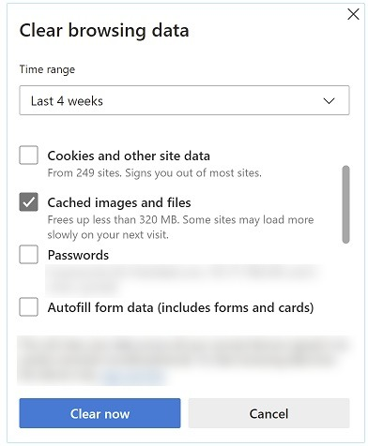
The Clear browsing data dialog with only Cached images and files selected.
-
-
No Content Security Policy (CSP) errors
- Press F12 to open the browser Developer Tools.
- Select the Console tab.
- Look for CSP errors that mention AppNavi, for example “Refused to load the script”, “Refused to execute a script” or “Refused to apply style”.
If you see CSP errors, your application’s security policy is blocking AppNavi. Share the Content Security Policy (CSP) Configuration Guide with the team that manages your application’s security settings.
- AppNavi files load in the Network tab
-
Open the application and press F12 to open Developer Tools.
-
Select the Network tab.
-
In the filter field, type an to show only AppNavi files.
-
Reload the page.
-
Check that these files are listed with status 200: an-core.js, an-core-dark.css and an-data-.js.
Expected result: All three files load with status 200, and the an-data-.js request contains the expected tenant information. If a file is missing or shows an error status, the request may be blocked by a CSP or your network. See Dealing with firewall configurations.
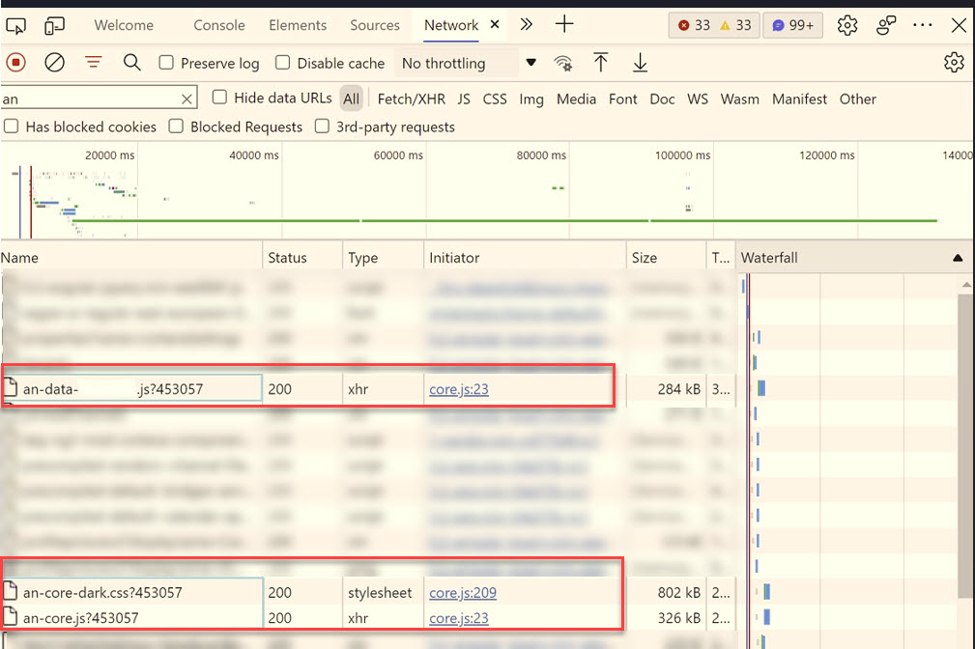
The Network tab filtered by “an”, showing the AppNavi files.
-
Run Avatar diagnostics
If the AppNavi Avatar still does not appear, use the Avatar Diagnostic for a deeper analysis.
If AppNavi still does not appear
If all checks above pass but AppNavi is still not displayed:- Verify that your browser is supported. See Browser Compatibility.
- Check whether the application uses iframes or other restrictions that could prevent AppNavi from loading. See Technical Restrictions.
- Check the Console and Network tabs for failed AppNavi requests.
- Confirm that your application’s security or network configuration does not block AppNavi resources.
- Contact AppNavi support with the information listed below.
Updated about 17 hours ago