
URL Blacklist
The URL Blacklist allows you to exclude specific pages from AppNavi Insights tracking and analytics.
This is useful when certain pages contain sensitive information or are not relevant to the analytics you want to collect.
When a page URL matches an active blacklist pattern, AppNavi excludes that page from Insights tracking, including:
- Tables
- Navigation
- Areas
- Event recordings
The URL Blacklist is configured separately for each application in Insights Settings.
When to Use URL Blacklist
Use URL Blacklist when you want to prevent specific pages or groups of pages from being included in Insights analytics.
Typical examples include:
- Pages containing sensitive information
- Administrative pages that are not relevant to user-behavior analysis
- Internal configuration pages
- Specific application sections that should not be tracked
- Pages where analytics are not required
For example, if an application contains a page such as:
/settings
you can create a URL pattern that prevents Insights from tracking that page.
The blacklist is intended to control Insights tracking. It does not represent the separate Discovery Blacklist, which controls whether web applications are discovered by AppNavi.
Before You Start
Before configuring URL Blacklist:
- Make sure the required application is available in Insights.
- Identify the pages or URL patterns that should not be tracked.
- Decide whether you need to exclude one page, a group of pages, or all pages.
- Make sure the URL pattern you create matches the intended page URL.
The URL Blacklist is configured at the application level through Insights Settings.
How URL Blacklist Works
The workflow is:
Identify pages → Open Insights Settings → Enable URL Blacklist → Add URL pattern → Activate the pattern → Verify tracking exclusion
The blacklist contains URL patterns rather than individual tracking events.
When the URL of a page matches an active pattern, that page is excluded from Insights tracking.
Access URL Blacklist
To open the URL Blacklist settings:
- Open the Insights tab.
- Select the required application.
- Click the three-dot menu.
- Select Insights Settings.
- Open the URL Blacklist tab.
The URL Blacklist configuration is available in this application-specific settings dialog.
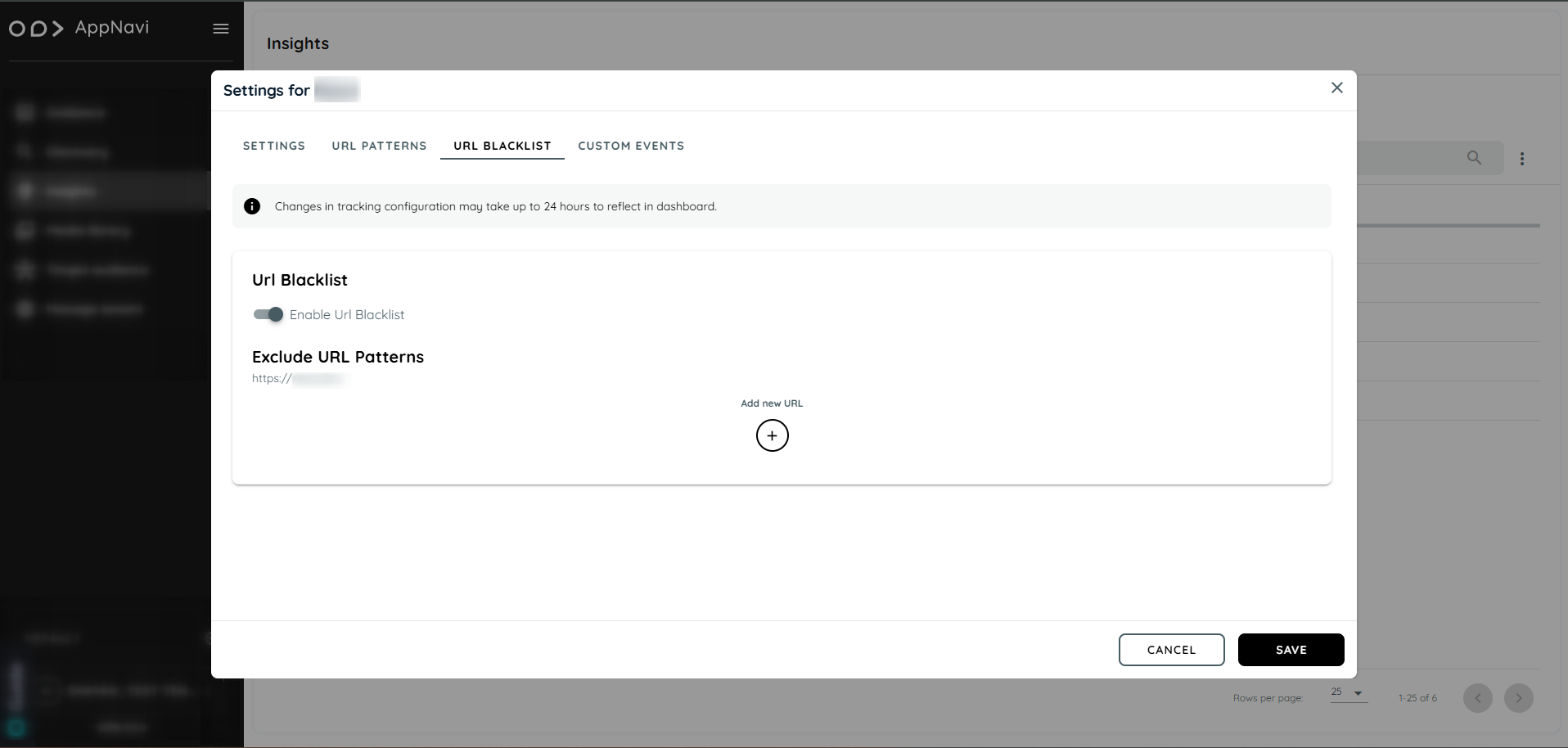
URL Blacklist
Enable URL Blacklist
To start using the feature:
- Open the URL Blacklist tab.
- Enable the URL Blacklist toggle.
- Confirm that the option to add a URL pattern is available.
- Click the plus (+) icon.
- Enter the required URL pattern.
- Enable the pattern.
- Save the configuration if required by the interface.
The URL Blacklist supports up to 25 URL patterns. Each pattern has its own enable/disable toggle.
URL Pattern Matching
URL Blacklist uses patterns to determine which pages should be excluded.
The current documentation provides the following examples:
| Pattern | Example Purpose |
|---|---|
www.example.com | Match a specific domain or URL |
/learn | Match a specific path |
example.* | Use a wildcard pattern |
*.example.com | Match a domain pattern using a wildcard |
The exact result depends on the URL being evaluated against the configured pattern. Always test a pattern against the actual application URL before relying on it for sensitive-page exclusion.
Example 1: Exclude a Specific Page
Suppose your application contains:
https://www.example.com/settings
and you do not want this page included in Insights analytics.
You can configure:
/settings
Expected behavior
When the configured pattern matches the page URL, the page is excluded from Insights tracking.
The exclusion applies to the Insights tracking categories documented for URL Blacklist:
- Tables
- Navigation
- Areas
- Event recordings
Example 2: Exclude a Group of Pages
Suppose your application has several pages under a particular section:
/admin/users/admin/settings/admin/permissions
You may use an appropriate wildcard pattern to target the required group of URLs.
Before enabling the pattern, verify that it does not also match pages that you still want to analyze.
This is particularly important when using broad wildcard patterns.
Example 3: Exclude All Pages
The documentation specifies that adding:
*
excludes all pages from Insights tracking.
This is therefore a broad exclusion and should only be used when the intention is to prevent Insights tracking across the application.
Understanding Active and Inactive Patterns
Each URL pattern has its own enable/disable toggle.
This allows you to keep a pattern in the configuration without applying it.
For example:
| Pattern | Status | Result |
|---|---|---|
/settings | Active | Matching pages are excluded |
/admin | Inactive | Pattern is not applied |
*.example.com | Active | Matching URLs are excluded |
This allows administrators to temporarily disable a rule without necessarily removing the pattern from the configuration.
What Happens When a URL Matches?
When a page URL matches an active URL Blacklist pattern, the page is excluded from all Insights tracking covered by the feature.
This includes:
- Tables
- Navigation
- Areas
- Event recordings
The purpose is to prevent the matching page from contributing to Insights analytics.
What Happens When No Patterns Are Configured?
If the URL Blacklist pattern list is empty, Insights tracking continues normally.
This means that simply opening the URL Blacklist settings does not exclude any pages.
An exclusion only applies when a relevant blacklist pattern has been configured and is active.
Understanding Broad Patterns
Be careful when creating broad patterns.
For example:
*
matches all pages and therefore excludes all pages from Insights tracking.
A broad pattern can therefore have a much larger effect than a specific path such as:
/settings
Recommended approach
Start with the narrowest pattern that meets your requirement.
For example:
Use
/settings
when you only need to exclude the settings page.
Avoid using:
*
unless the requirement is to exclude all pages from Insights tracking.
URL Blacklist and Sensitive Pages
URL Blacklist can be useful as part of an organization's data-protection approach.
For example, an application may contain:
- Employee administration pages
- Account settings
- Internal configuration pages
- Sensitive business information
If those pages should not be included in Insights analytics, you can configure matching URL patterns.
Example
Suppose an HR application contains:
/employees
/employees/payroll
/employees/settings
If these pages should not be tracked through Insights, determine the appropriate URL patterns and configure them before analytics are collected for those pages.
The customer is responsible for determining which application pages should be excluded according to their own privacy, security, and analytics requirements.
URL Blacklist vs. Discovery Blacklist
These two features serve different purposes and should not be confused.
| Feature | Purpose |
|---|---|
| URL Blacklist | Excludes matching pages from Insights tracking and analytics |
| Discovery Blacklist | Prevents applications matching configured patterns from being discovered by AppNavi |
The URL Blacklist is configured from Insights Settings for a specific application. The Discovery Blacklist is configured through Discovery Settings and affects application discovery.
Example
If you want to:
Stop Insights from tracking /settings
use URL Blacklist.
If you want to:
Prevent a website or application pattern from being discovered
use the Discovery Blacklist.
These are separate controls.
URL Blacklist and Insights Configuration
URL Blacklist controls which pages are excluded from Insights tracking.
Other Insights settings control what is tracked on pages that remain in scope.
For example, AppNavi Insights can use configuration for areas, URL filters, activity tracking, target audiences, and automatically detected interactive elements.
The URL Blacklist should therefore be considered an exclusion layer for pages that should not participate in Insights analytics.
Configuration Workflow for Administrators
Use the following workflow when implementing URL Blacklist for an application.
Step 1 — Identify the Pages
List the pages that should not be tracked.
Example:
/settings/admin/user-profile
Step 2 — Check the URLs
Open the relevant pages in the application and confirm the actual URL structure.
This helps prevent creating patterns that are too broad or too narrow.
Step 3 — Configure the Blacklist
Navigate to:
Insights → Application → Three-dot menu → Insights Settings → URL Blacklist
Enable the URL Blacklist feature.
Step 4 — Add Patterns
Add the required URL patterns.
Use specific patterns where possible.
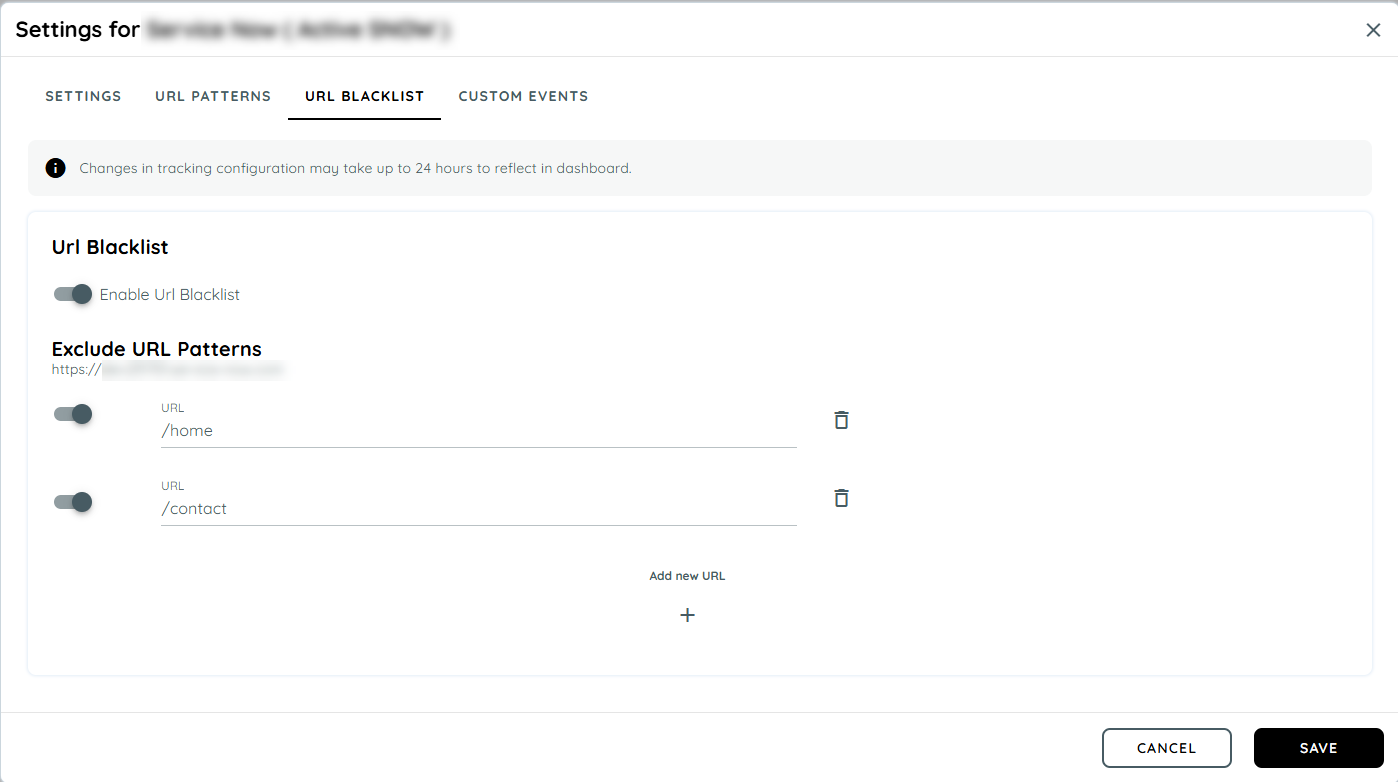
Step 5 — Activate the Patterns
Enable each pattern that should currently be applied.
Step 6 — Validate
Open a page that should be excluded and verify that it is no longer included in the applicable Insights tracking.
Also test a page that should remain tracked to make sure the pattern did not unintentionally exclude additional pages.
Validation Example
Suppose the requirement is:
Do not track the
/settingspage, but continue tracking the rest of the application.
Configure:
/settings
Then validate:
| Page | Expected Result |
|---|---|
/settings | Excluded from Insights tracking |
/dashboard | Remains available for Insights tracking |
/reports | Remains available for Insights tracking |
/settings/users | Verify according to the configured pattern and actual URL matching |
The last case is important because URL pattern behavior should be validated against the actual URLs used by your application.
Updated 16 days ago