
URL Pattern
URL Patterns help define which web pages or sections of an application should be tracked in AppNavi's Insights module. This feature allows portal users to create meaningful tracking points by specifying parts of the URL or entire paths. Whether it's for a homepage, a search page, or deeper navigation paths, URL patterns make it possible to capture insights precisely and efficiently.
Overview
URL Patterns offer three key configurations to control exactly what user interactions are tracked:
| Configuration Type | Purpose |
|---|---|
| Segments | Break the URL into defined parts to gain deeper insights into specific sections of user journeys |
| Specific URLs | Define exact pages you want to track with custom titles for easy identification in reports |
| Auto-Generated Patterns | Let the system suggest patterns based on user activity to automatically capture tracking points |
With this control, organizations can align tracking to how users actually navigate, making the analytics more relevant and actionable.
When to Use URL Patterns
Use URL Patterns to:
• Track specific sections or pages within your application
• Analyze user navigation patterns across different URL paths
• Monitor performance of specific features or workflows
• Create meaningful segments for detailed journey analysis
• Automate tracking configuration based on actual user behavior
• Generate custom titles for better report readability
• Establish consistent tracking across multiple applications
Prerequisites
Before configuring URL Patterns, ensure you have:
• Access to the Insights module in AppNavi
• Selected an application to configure
• Understanding of your application's URL structure
• Required permissions to modify application settings
• Identified the pages and sections you want to track
How to Access URL Pattern Settings
Follow these steps to navigate to the URL Pattern configuration:
- From the main menu, click on the Insights tab
- Select any application from the applications list
- Click on the context menu (three dots) for the selected application
- Click on the "Settings" tab from the menu options
- Click on the "URL Pattern" tab in the top menu
- You will now see the three URL Pattern configuration options: Segments, Specific URLs, and Auto-Generated Patterns
URL Segments Configuration
What Are URL Segments?
URL Segments allow you to define specific parts of a URL to gain deeper insights into user journeys. By breaking URLs into segments, you can analyze particular sections of your web traffic more accurately and understand user behavior at a granular level.
How to Configure URL Segments
- In the URL Pattern tab, find the Segments section
- Click the toggle button to activate URL segmentation
- Input a numeric value representing how many parts of the URL should be included in the analysis
- Alternatively, use the up arrow to increase segments or the down arrow to decrease
- As you add segments, observe the URL preview to see how the base URL transforms
- Save your segment configuration to apply the tracking

URL Pattern
URL Segment Configuration
URL Segments Example
Example transformation with URL segmentation:
- Base URL: https://google.de
- With Segment Value of 1: https://google.de/{{part1}}
- This configuration tracks the first segment after the domain, allowing analysis of top-level sections (e.g., /search, /images, /maps).
- With Segment Value of 2: https://google.de/{{part1}}/{{part2}}
- This tracks two levels deep, capturing more detailed navigation paths (e.g., /search/images, /search/videos).
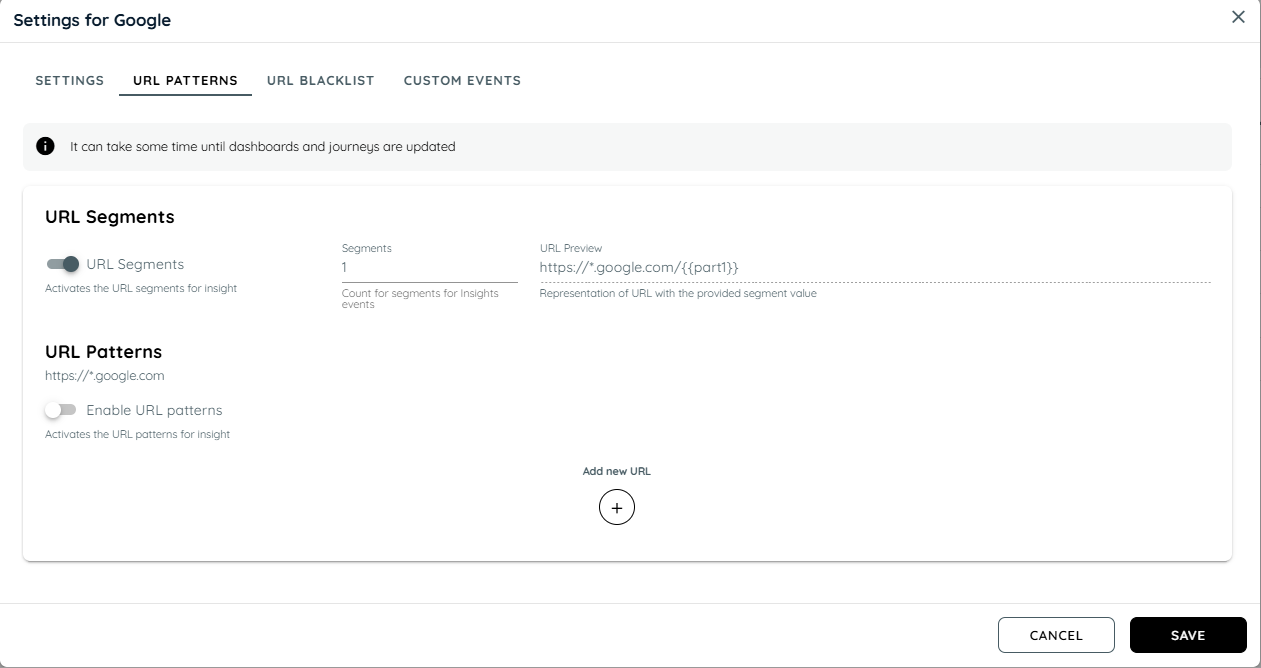
Enable URL Segments toggle and set segment value to track URL parts
Specific URLs Configuration
What Are Specific URLs?
The Specific URL feature allows you to define exact URL entries that the system will match against broader URLs. This is useful for tracking specific pages and assigning meaningful titles to them for better reporting.
How to Configure Specific URLs
- In the URL Pattern tab, find the Specific URL section
- Type the URL paths you want to track. You can enter as many URL entries as needed
- The system will match your specified entries against larger URLs automatically
- For each URL, assign a title that will display in analytics reports as the Page Title
- Save your specific URL configuration to activate tracking
- Check that URLs and their titles appear correctly in your analytics reports

Specific URL
Enable URL patterns toggle and add specific URLs with custom titles for tracking
Specific URLs Example
URL matching with Specific URLs:
If you specify: https://google.de/search
The following URLs will also be included in analysis:
• https://google.de/search/images
• https://google.de/search/videos
• https://google.de/search/news
Custom Title Example: If you assign the title "Search Results" to https://google.de/search, all matching URLs will be grouped and labeled as "Search Results" in your analytics reports.
Generate Auto URL Patterns
What Are Auto-Generated Patterns?
The Auto-Generated Patterns feature analyzes actual user behavior in your application and automatically suggests URL patterns that are relevant to your users' navigation. This eliminates the need for manual pattern configuration and ensures you're tracking what users actually do.
How to Configure Auto-Generated Patterns
- In the URL Pattern tab, find the "Generate Auto URL Patterns" section
- Click the toggle switch to activate the auto-generation feature
- Click the "Generate URL Patterns" button to automatically create patterns
- View the list of automatically generated URL patterns
- By default, all patterns are disabled. Enable the patterns you want to track
- Save your pattern selection to apply the tracking
Auto-Generated Patterns Details
Key features of auto-generated patterns:
• Button Visibility: The "Generate URL Patterns" button only appears when the toggle is enabled
• Pattern Limit: Maximum of 25 URL patterns can be generated per application
• Default State: All generated patterns start in a disabled state
• Manual Control: You can selectively enable only the patterns relevant to your analysis
• Based on Activity: Patterns are generated from actual user behavior in your application

Auto Generating Pattern
Refresh button to automatically generate URL patterns based on actual user activity in the application.
Interpreting URL Pattern Metrics
Once URL Patterns are configured, the Insights dashboard will display metrics based on your tracking setup:
| Metric | Interpretation |
|---|---|
| Page Views by Pattern | Shows the number of times users accessed each tracked URL pattern |
| User Journey Paths | Displays the sequence of pages users visit within your application |
| Pattern Performance | Indicates which sections are most engaging or have performance issues |
| Conversion Paths | Tracks specific paths users take before completing desired actions |
Validating URL Pattern Configuration
After setting up URL Patterns, verify that tracking is working correctly:
- Visit the pages you configured for tracking in your application
- Go to the Insights dashboard and review the tracked metrics
- Confirm that custom titles appear correctly in reports (for Specific URLs)
- Check that URL segments are being captured at the correct depth
- If using auto-generation, verify that suggested patterns are accurate
- Navigate through different sections to ensure all relevant paths are tracked
Related Document
The following features work in conjunction with URL Patterns:
• Insights Dashboard - View metrics generated from your URL patterns
• Application Settings - Configure application-wide tracking options
• User Activity Tracking - Monitor detailed user interactions within tracked URLs
• Analytics Reports - Generate reports based on URL pattern data
• Event Tracking - Combine URL patterns with custom event tracking
• Data Filtering - Filter and segment URL pattern data in reports
Summary
| Feature | Purpose |
|---|---|
| Segments | Break URLs into flexible parts for better grouping |
| Specific URLs | Manually define key pages and assign titles |
| Auto Generator | Automatically detect and suggest useful patterns |
The URL Patterns feature allows precise control over which pages are tracked in Insights, ensuring high-quality, accurate analytics. It helps simplify data, highlight relevant user journeys, and keep reporting consistent — all with just a few clicks.
Updated about 10 hours ago