Discovery Reports
Discovery Reports provide downloadable Excel reports that help you analyze how applications are used across departments, countries, and business processes.
The reports combine application usage, user activity, compliance information, risk-related attributes, and user segmentation. You can use them for application reviews, governance activities, compliance checks, license optimization, audit preparation, and management reporting.
This guide explains how Discovery Reports work, what data they contain, how to select the reporting period, and how to use the results for governance and analysis.
Before You Start
Before generating a Discovery Report:
- App Discovery must be available and collecting or containing Discovery data.
- You need access to the Discovery area in the AppNavi Portal.
- Applications and user activity must be available for the selected reporting period.
- If you are working with a newly created tenant, you can use Discovery Demo Data to explore the reports with sample data.
For more information, see App Discovery and Discovery Demo Data.
How Discovery Reports Work
The typical workflow is:
Collect Discovery data → Open App Overview → Select a report → Select the reporting period → Generate Excel report → Analyze the results → Take governance or business action
Discovery collects application usage information from supported Discovery events. The available report data is then aggregated for the selected reporting period.
Reports only contain data that meets the criteria for the selected time period.
What Data Does Discovery Use?
Discovery reports are based on application and user activity data available in Discovery.
Depending on the report, the exported data can include:
- Application
- Department
- Country
- Business Process
- Total Users
- User activity segmentation
- Average Daily Usage per User
- Data Classification
- PII information
- Criticality
- Data Residency
- AI application information
The exact fields depend on the selected report.
Discovery activity includes information such as the application URL, user identifier, session information, timestamp, and activity time. Discovery records activity time based on user interaction with the web page and does not record user input.
Important Data Consideration
Report results depend on the Discovery data available for the selected period.
For example, if an application was not used during the selected period, it will not contribute usage data to the report for that period.
Accessing Discovery Reports
To generate a report:
-
Open the AppNavi Portal.
-
Navigate to Discovery.
-
Open App Overview.
-
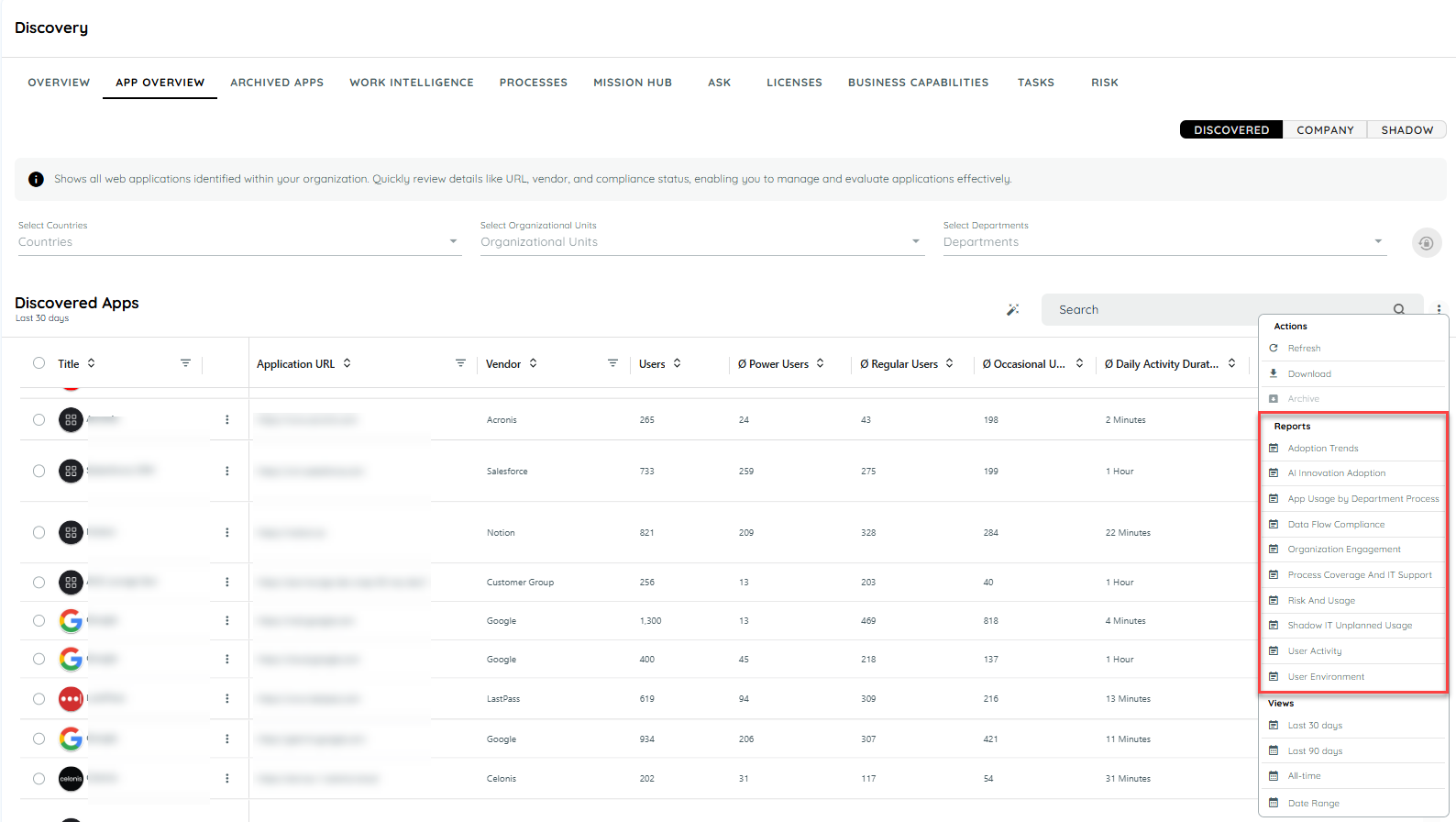
Click the three-dot menu.
-
Select the required report type.
-
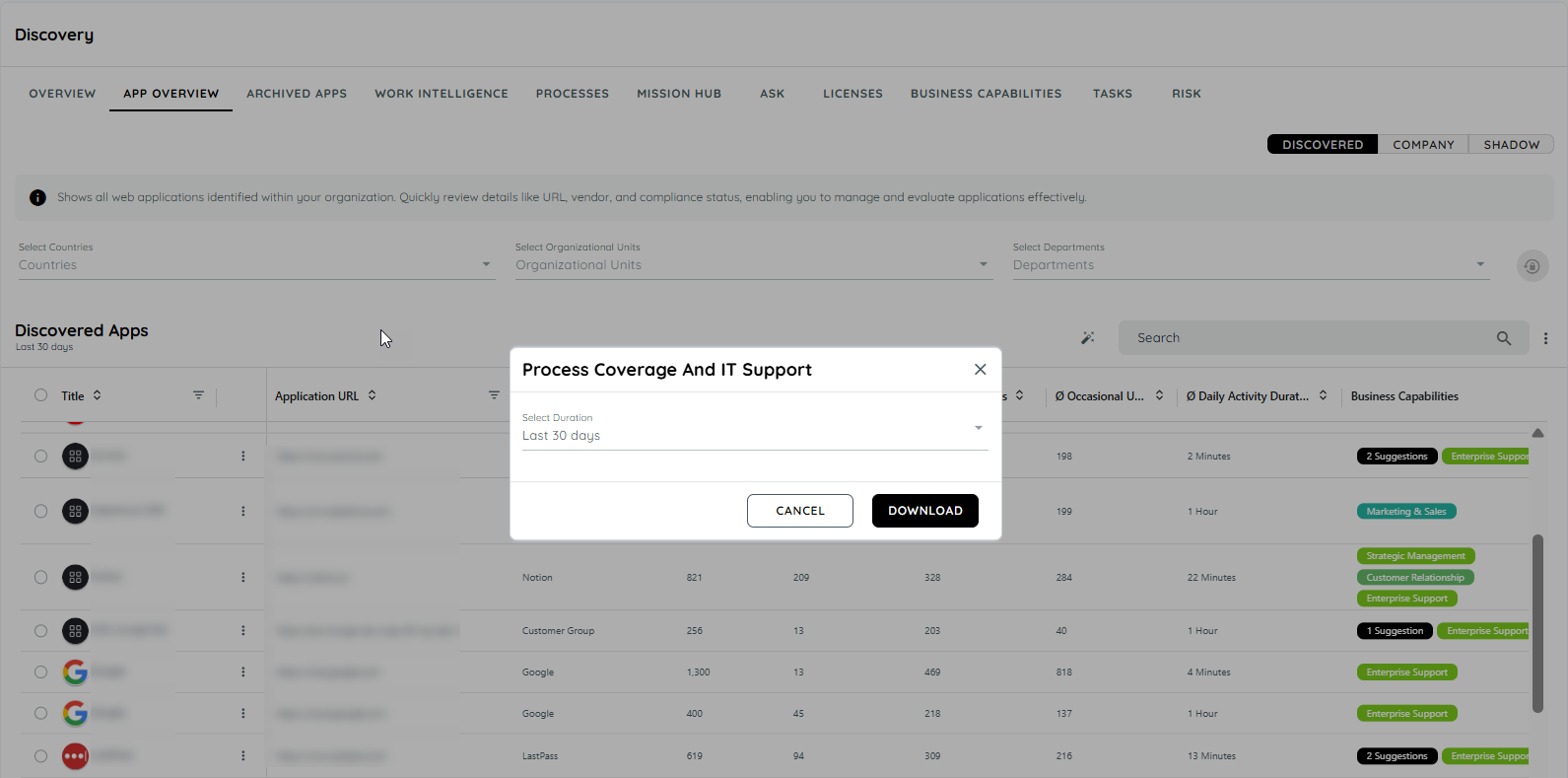
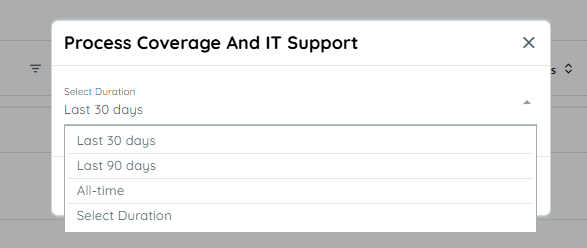
Select the reporting period.
-
Choose one of the available date ranges:
- 30 Days
- 90 Days
- All Time
- Custom Date Range
-
Generate the report.
-
Discovery downloads the report as an Excel file containing aggregated metrics and user segmentation details.
Understanding the Reporting Period
The selected reporting period determines which Discovery data is included in the generated report.
| Date Range | Use Case |
|---|---|
| 30 Days | Review recent application usage and adoption |
| 90 Days | Identify broader usage patterns and trends |
| All Time | Review the complete available Discovery history |
| Custom Date Range | Analyze a specific business period, review period, or audit window |
Example
If you select Last 30 Days, the report contains data that meets the report criteria during that period.
If you select Last 90 Days, the same report can provide a broader view of application adoption and user activity.
The date range should therefore be selected based on the question you are trying to answer.
Time Frames
Filters and Report Scope
The documented report generation workflow provides a date-range selection when creating the report.
The App Overview itself also provides filters such as:
- Country
- Organizational Unit
- Department
These filters can change the applications and analytics displayed in App Overview. They are useful when investigating a particular user population before reviewing application details.
For example:
Country: Germany
Organizational Unit: IT
Department: Development
The App Overview then reflects the selected user population.
Important: Do not assume that every App Overview filter is an independent filter available inside every exported Discovery Report. The documented report workflow specifically requires selecting the report type and reporting period.
Available Reports
1. Process Coverage & IT Support Report
What it shows
This report shows how applications are used across business processes and departments, including the frequency of user activity.
Main fields
| Field | Description |
|---|---|
| Business Process | Business process associated with the application, such as Procure to Pay or Lead to Cash |
| Application | Discovered application in use |
| Department | Department using the application |
| Country | User location based on available metadata |
| Total Users | Number of unique users during the selected period |
| Power / Regular / Occasional Users | User activity-frequency segmentation |
| Avg. Daily Usage/User | Average activity time per user per day |
How to use it
Use this report when you need to understand:
- Which applications support important business processes
- Which departments depend on an application
- Where application usage is concentrated
- Where additional IT support or enablement may be required
Example
Suppose the Procure to Pay process uses an application heavily in Finance but only occasionally in another department.
The report can help IT understand where support demand is concentrated and where additional user enablement may be useful.
2. App Usage by Department/Process Report
What it shows
This report provides a department-level view of application adoption across business processes.
Main fields
| Field | Description |
|---|---|
| Department | Department using the application |
| Application | Discovered application |
| Country | User location based on metadata |
| Business Process | Associated business process |
| Total Users | Unique users during the selected period |
| Power / Regular / Occasional Users | User activity-frequency segmentation |
| Avg. Daily Usage/User | Average activity time per user per day |
How to use it
This report can help identify:
- Differences in application adoption between departments
- Underused applications
- Multiple applications being used for similar processes
- Potential opportunities for license or application optimization
Example
If two departments use different applications for the same business process, compare their user counts and activity levels.
This can provide a starting point for an application rationalization or license review.
3. Shadow IT / Unplanned Usage Report
What it shows
This report focuses on unapproved or Shadow IT applications that are not part of the official IT catalog.
Main fields
| Field | Description |
|---|---|
| Application | Discovered application |
| Department | Department using the application |
| Contains Personal Data / Sensitive Data | Indicates potential data exposure |
| Business Process | Associated business process |
| Criticality | Application risk or business impact classification |
| Data Residency | Application data hosting region |
| AI Tool Flag | Indicates whether the application uses AI features |
| Country | User location |
| Total Users | Unique users during the selected period |
| Power / Regular / Occasional Users | User activity-frequency segmentation |
| Avg. Daily Usage/User | Average activity time per user per day |
How to use it
Use this report to identify:
- Applications being used without official IT approval
- Departments relying on unapproved applications
- Applications that may involve personal or sensitive data
- Applications that require security, compliance, or governance review
Example
A department may use an online tool that is not part of the organization's approved application catalog.
If the report shows that the tool is used by many employees and handles sensitive data, the application can be prioritized for further review.
4. Data Flow / Compliance Report
What it shows
This report connects application usage with data sensitivity and classification information.
Main fields
| Field | Description |
|---|---|
| Business Process | Related business process |
| Application | Application name |
| Department | Department using the application |
| Country | User location |
| Total Users | Unique users during the selected period |
| Usage Segmentation | Power, Regular, and Occasional users |
| Avg. Daily Usage/User | Average daily engagement time |
| Data Classification | Type of data handled, such as HR, Financial, or Customer |
| Contains PII? | Indicates whether the application handles personally identifiable information |
| Criticality | High, Medium, or Low impact classification |
How to use it
This report can support:
- Data-protection reviews
- Privacy assessments
- Security investigations
- Identification of applications handling PII
- Audit preparation
- Prioritization of applications for further review
Example
If an application is associated with Customer data and indicates that PII is involved, a compliance team can use the report as a starting point for reviewing how that application is used and whether additional controls are required.
5. Risk & Usage Report
The Risk & Usage Report focuses on Shadow Applications and combines usage information with risk-related application attributes.
What it shows
It helps answer three basic questions:
- Which unapproved applications are being used?
- Who is using them and how frequently?
- What risk-related characteristics are associated with them?
Main fields
| Field | Description |
|---|---|
| Application Name | Shadow application being used |
| Department | Department of the users |
| Country | User location |
| Total Users | Unique users during the selected period |
| Avg. Daily Usage/User | Average daily usage time per user |
| Contains Personal Data | Indicates whether the application processes PII |
| Contains Sensitive Data | Indicates whether sensitive data is involved |
| Criticality | High, Medium, or Low classification |
| Data Residency | Application data location, such as EU, US, or Global |
| AI Productivity Tool | Indicates whether the application is marked as an AI-powered tool |
How to use it
The report can support:
- Shadow IT reviews
- Security assessments
- Compliance assessments
- Risk remediation
- Audit preparation
- IT governance activities
Example
An unapproved application has:
- High criticality
- Sensitive data usage
- Users in multiple departments
- High daily usage
This combination provides a clear reason for the application to be reviewed by the appropriate IT, Security, or Compliance team.
The report itself does not replace your organization's risk assessment process. It provides data that can support that process.
6. AI Innovation Adoption Report
What it shows
The AI Innovation Adoption Report measures the use of applications identified as AI-powered.
It provides visibility into AI application adoption across departments and countries.
Main fields
| Field | Description |
|---|---|
| AI Apps Used | Number of AI-flagged applications used |
| AI Users | Unique users who used at least one AI application |
| AI Adoption Rate | Percentage of users who used AI applications |
| Power / Regular / Occasional Users | User activity-frequency segmentation |
| Avg. Daily Usage/User | Average daily usage time per user |
How to use it
The report can support:
- AI adoption analysis
- Department-level comparisons
- AI enablement planning
- Digital transformation planning
- AI investment discussions
- Understanding actual engagement with AI applications
Example
If the report shows that the Engineering department has a higher AI adoption rate than other departments, leadership can use this information to investigate existing use cases and identify where additional AI enablement may be appropriate.
The report describes usage and adoption; it does not by itself measure whether an AI application is beneficial or appropriate for a particular business purpose.
Understanding User Segmentation
Several Discovery Reports use three activity-frequency segments:
- Power Users
- Regular Users
- Occasional Users
These segments help you understand how frequently users engage with an application during the selected reporting period.
The underlying Discovery documentation defines the segments based on average active days per week:
| Segment | Definition |
|---|---|
| Power Users | More than 4 days per week on average |
| Regular Users | 2 to 4 days per week on average |
| Occasional Users | Less than 2 days per week on average |
Only users who accessed the application at least once during the selected period are counted.
Example
Consider an application with 100 users:
- 20 Power Users
- 50 Regular Users
- 30 Occasional Users
This tells you how usage is distributed across the application's users. It does not mean that Power Users are necessarily more important or that Occasional Users are underperforming.
Understanding Average Daily Usage
Avg. Daily Usage/User represents the average activity time per user per day for the selected reporting period.
For example, if a report shows:
Avg. Daily Usage/User: 25 minutes
this indicates that the reported users averaged 25 minutes of activity per day during the selected period.
Use this metric together with Total Users and the user segments rather than interpreting it in isolation.
How to Validate a Report
After downloading a report, perform the following checks:
- Confirm that the selected report type is correct.
- Confirm that the selected date range matches the period you want to analyze.
- Check that applications shown in the report are expected.
- Review the Total Users column.
- Review the user segmentation.
- Check department and country information where available.
- Review risk, compliance, data, or AI-related fields depending on the report.
- Compare the results with the corresponding Discovery information when investigating an individual application.
- Use the Excel data for further analysis or internal reporting.
Using Reports for Governance
Discovery Reports can support different governance workflows.
Application Governance
Use application usage information to identify:
- Highly used applications
- Underused applications
- Applications used across multiple departments
- Applications that may require formal ownership or review
Security and Compliance
Use risk and compliance reports to identify applications that may require:
- Security assessment
- Privacy review
- Data-protection review
- Risk classification
- Follow-up investigation
Shadow IT Management
Use Shadow IT reports to:
- Identify an unapproved application.
- Determine which departments use it.
- Review the number of users.
- Review data and risk-related attributes.
- Assess whether the application requires further investigation.
- Apply the organization's governance process.
License and Cost Review
Usage information can help identify applications with:
- High adoption
- Low adoption
- Different adoption levels across departments
- Potentially overlapping usage
The report provides usage evidence that can be considered during license and application optimization.
Concrete Governance Example
Scenario
An organization discovers that a previously unknown AI application is being used by the Finance department.
Step 1 — Identify Usage
Use the Shadow IT / Unplanned Usage Report or Risk & Usage Report to identify the application and its users.
Step 2 — Understand the Scope
Review:
- Total users
- Department
- Country
- Average daily usage
- User activity segmentation
Step 3 — Review Risk Information
Check available information such as:
- Personal data
- Sensitive data
- Criticality
- Data residency
- AI application status
Step 4 — Investigate
The appropriate IT, Security, Compliance, or business owner can review the application according to the organization's governance process.
Step 5 — Take Action
Depending on the organization's policies, the application may be:
- Reviewed for approval
- Added to an application governance process
- Assessed for security or compliance
- Monitored for continued usage
- Included in an application rationalization exercise
The appropriate action depends on the organization's internal policies and risk-management process.
Related Documentation
- App Discovery — Understand how applications are discovered, what Discovery data is collected, and how Discovery analytics work.
- Discovered Apps Overview — Review discovered applications, time periods, filters, application metrics, and application-level analytics.
- Discovery Demo Data — Import sample Discovery data to explore Discovery functionality on a test tenant.
Updated 7 days ago