User Management
What is the User Management
AppNavi supports two types of users: anonymous end users and portal users.
Anonymous users - maximum protection of personal data
End users can use AppNavi anonymously. This means that they do not need to authenticate with AppNavi to use AppNavi content in the integrated application.
Anonymous usage helps minimize the amount of personal information stored by AppNavi. AppNavi does not require end users to have an AppNavi Portal account just to access AppNavi content.
Only users who need to manage AppNavi content or administration features, such as authors and administrators, need a portal account. For these users, AppNavi stores account information such as their first name, last name, and email address.
When is Authentication Required?
Authentication is required when a user needs to access the AppNavi Portal or perform administrative and content-management activities.
For example, portal users need to authenticate when they need to:
- Manage users and their permissions.
- Manage tenant or workspace settings.
- Create or manage AppNavi content.
- Access administration features available to their assigned role.
End users who only consume AppNavi content within an integrated application can use AppNavi without a portal account.
For more information about authentication and access control, see the Role & Permission Model.
The Right Role for Everyone
AppNavi has a role and permission model that supports different activities and responsibilities.
- Tenant Owner – manages the full tenant.
- Workspace Owner – manages users and content within authorized workspaces.
- Contributor – manages content within assigned workspaces or applications.
- Translator – translates existing content in assigned languages.
- Extended Contributor – manages applications and application content according to assigned permissions.
For more information about roles and permissions, see the Role & Permission Model.
Easy management of users and roles
Users can be added to a tenant and workspace through the AppNavi Portal and assigned the appropriate role and permissions.
New portal users receive an activation email. They confirm their email address, set their password, and can then sign in to the AppNavi Portal according to their assigned permissions.
The User Management page allows administrators to create and manage portal users, assign workspaces and roles, resend invitations, reset passwords, and configure available user options.
For step-by-step instructions, see Manage Users.
Privacy and User Access
Anonymous end-user access and authenticated portal access serve different purposes
| User type | Authentication | AppNavi account | Typical access |
|---|---|---|---|
| Anonymous end user | Not required for normal AppNavi content usage | NO | Uses AppNavi content within an integrated application |
| Portal user | Required | YES | Manages content, users, workspaces, or other administrative functions according to assigned permissions |
This separation helps limit personal data collection for end users while ensuring that administrative and content-management activities are performed by authenticated users with appropriate permissions.
Discovery Roles
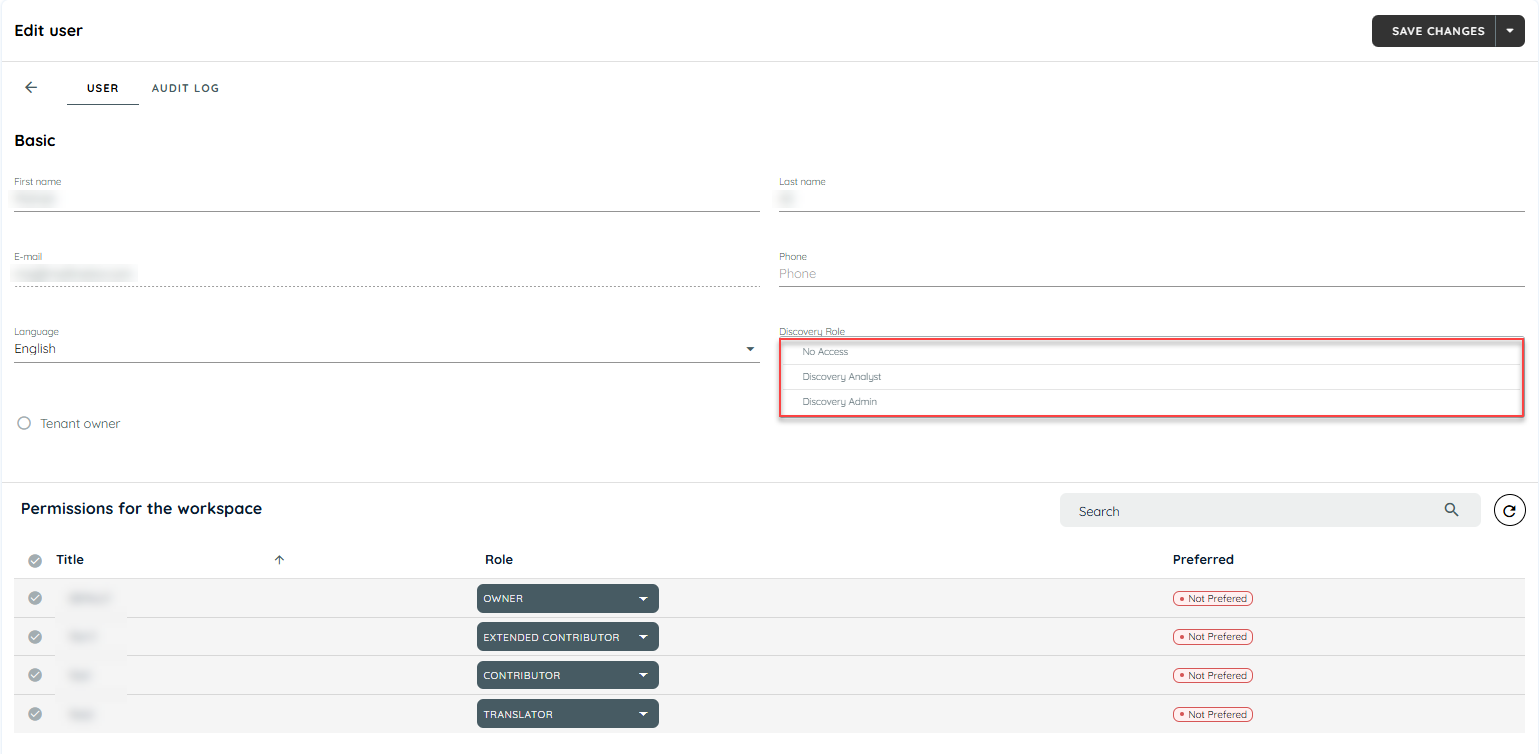
AppNavi has introduced roles for Discovery users in the User Management module. A Tenant Owner can create a user and assign Discovery roles according to their requirements.
Discovery Admin:
The Discovery Admin has access to all available Discovery features. If a user is a Tenant Owner, they automatically have access to Discovery Admin-related features that are available to them.
Discovery Analyst:
The Discovery Analyst has access to Discovery features except for Discovery Settings, Import, and Reset Data.
For more information about managing users and assigning roles, see Manage Users.
Updated 19 days ago