
Discovery Apps (v1)
Retrieve applications discovered by users to help locate all web-based applications frequently used within an organization.
Endpoint URL
POST https://api-prod-eu-central-1.inappnavi.com/api/public/v1/{{tenantId}}/discovery/discoveryApps Purpose
Retrieves a list of discovered applications for the specified time period, including usage metrics and other data displayed in the AppNavi UI.
Before You Begin
Make sure you have the following before calling this endpoint:
• Public API credentials (Client ID and Client Secret). See Getting Started with the Public API.
• Your tenant ID, which replaces {{tenantId}} in the endpoint URL.
• A valid bearer token. See Acquire Authentication Token.
How to Use This Endpoint
A typical integration follows this workflow:
• Authenticate: request a bearer token with your client credentials and send it in the Authorization header of every request.
• Choose the time period: set timeRange, or provide fromDate and toDate together with VIEW_CUSTOM_DAYS.
• Select the data you need: list only the fields you need in displayedColumns to keep responses small. The meaning of each field is explained in Description of Fields below.
• Page through the results: increase page to retrieve further results. The metaData object in each response shows the current page and items per page.
• Use the data: for example, load it into your CMDB, software asset management tool, or BI dashboard to track usage, shadow IT, and compliance.
Example: to list the AI productivity tools used in your organization over the last 90 days, send timeRange: "VIEW_90_DAYS" with displayedColumns: ["title", "url", "userCount", "isAIProductivityTool"], then keep the results where isAIProductivityTool is true.
Request Structure
When making a POST request to /discoveryApps ,include the authentication token in the header and include the following JSON body. Below is a common example; parameter names or structures may differ based on your final OpenAPI documentation:
| Parameter | Type | Required | Description |
|---|---|---|---|
QueryParams | QueryParams | Yes | The Additional data required to process API request |
QueryParams Parameters:
QueryParams Parameters:| Parameter | Type | Required | Description |
|---|---|---|---|
fromDate | string | No | Start date in YYYY-MM-DD HH:MM:SS format. If provided, set TimeRange to VIEW_CUSTOM_DAYS. |
toDate | string | No | End date in YYYY-MM-DD HH:MM:SS format. If provided, set TimeRange to VIEW_CUSTOM_DAYS. |
timeRange | string | No | Possible values include LAST_30_DAYS, VIEW_90_DAYS, VIEW_ALLTIME and VIEW_CUSTOM_DAYS. If set to VIEW_CUSTOM_DAYS, you should provide fromDate and toDate. If not specified default to LAST_30_DAYS. |
page | integer | No | The page number to retrieve data from. Defaults to 1. |
itemsPerPage | integer | No | The number of items to retrieve per page. Defaults to 50, if not specified. |
displayedColumns | Array of Strings | No | The list of property/column names to include in the response. Available |
Description of Fields
This table provides a detailed overview of all application fields, including their technical (API) names, data types, corresponding UI labels, descriptions and data sources. It helps map backend data structures to the user interface and clarifies whether each field is automatically populated or manually maintained.
| Technical Name (API) | Type | UI Name | Description | Source |
|---|---|---|---|---|
| title | string | Title | Name of the application | Manual (Editable) |
| url | string | Application URL | Base URL of the app | Automatically |
| vendor | string | Vendor | Application provider | Manual / SaaS |
| businessCapabilityIds | Array | Business capabilities | Business mapping | Manual / Suggested |
| dataClassification | Array | Data classification | Defines the type and sensitivity level of data handled by the application | Auto / Derived (based on detected data patterns or policies) |
| businessProcess | Array | Business Process | Indicates which organizational process the application supports (e.g., HR, Finance, Marketing). Helps align apps with business functions. | Manual / Suggested |
| category | string | Category | App classification | Manual |
| hosting | string | Hosting | Specifies where the application is hosted (e.g., Private Cloud, Public cloud, On-Premise). Useful for security, compliance, and infrastructure decisions. | Auto / SaaS Metadata |
| compliant | boolean | Compliant | Indicates whether the application meets organizational or regulatory compliance standards. Typically shown as Yes/ No status based. | Derived / Policy-based |
| criticalityLevel | string | Criticality Level | Represents how critical the application is for business operations (e.g., Low, Medium, High, Mission Critical). Helps prioritize risk and incident handling. It can be shown as High, Medium and Low | Manual |
| dataLocation | string | Primary data location | Hosting/data region | Automatically |
| users | integer | Users | Total unique users | Automatically |
| powerUserCount | integer | Power Users | Users active > 4 days/week | Auto (Calculated) |
| regularUserCount | integer | Regular Users | Users active 2- 4 days/week | Auto (Calculated) |
| occasionalUserCount | integer | Occasional Users | Users active < 2 days/week | Auto (Calculated) |
| medianScore | string | Copy /Paste Count | Shows the qualitative score derived from the median based on events of copy and paste. High – Frequent copy/paste activity detected. | Auto (if enabled) |
| hasSensitiveData | boolean | Sensitive data/PII | Indicates whether the application handles sensitive or personally identifiable information (PII). Used for risk classification and compliance checks. Shown as Yes/ No status based. | Automatically |
| inflowScore | string | PII Inflow Risk | Indicates personal data presence. High – Significant amount of PII is being entered into the application. | Automatically |
| outflowScore | string | PII Outflow Risk | Indicates sensitive data risk. High – High volume of PII being copied or exported | Automatically |
| isAIProductivityTool | boolean | AI Productivity Tool | Identifies AI-based tools. It is shown as Yes/ No status based. | Automatically |
| ssoUsageRatio | string | SSO Usage | Shows the usage of SSO on applications which are accessed via Single Sign-On (SSO). High – Majority of users access the application via SSO | Derived / Integration-based |
| activityTime | double | Avg. daily Activity duration | Represents the average time users spend on the application per day. Useful for measuring engagement and usage intensity. | Automatically |
| firstSeen | string | First Seen | First time app detected | Automatically |
| lastSeen | string | Last Seen | Last activity timestamp | Automatically |
SaaS Catalog Data Inheritance
This table presents the relationship between applications and the SaaS catalog by indicating which fields are automatically inherited and which are maintained manually. Applications recognized in the SaaS catalog benefit from predefined metadata, ensuring consistency and reducing manual effort, while non-catalog applications require user-defined inputs.
| Properties Inherited from SaaS Catalog | Description |
|---|---|
| Title | Name of the application |
| Vendor | Application provider |
| Category | App classification |
| Privacy Policy | Policy URL |
| Terms of Services | Legal terms URL |
| Sensitive Data | Indicates whether the application handles sensitive or personally identifiable information (PII). |
| AI Productivity Tool | Identifies AI-based tools |
| Data Classification | Defines the type and sensitivity level of data handled by the application |
| Business Capability Ids | Represents the unique identifiers of the business capabilities associated with the application. These IDs are used to map the application to specific organizational functions (e.g., Finance, HR, Marketing) |
| SaaS Meta | Contains metadata provided by the SaaS catalog for recognized applications. This may include predefined attributes such as vendor, category, hosting type, compliance information, and other standardized details used to enrich application data. |
| Application Id | A unique identifier assigned to each application within the system. It is primarily used for API operations, data retrieval, and internal referencing. |
| Application Logo | Represents the visual icon or logo of the application displayed in the UI. This helps users quickly identify applications. Logos may be automatically fetched from the SaaS catalog or manually uploaded for custom applications. |
Example: Calling via Postman
- Open Postman and create a new POST request.
- Set the Request URL to:
https://api-prod-eu-central-1.inappnavi.com/api/public/v1/{{tenantId}}/discovery/discoveryApps- Compose the Body:
- In the Body tab, choose raw and then JSON.
- Enter the required parameters in the request body.
{
  "queryParams": {
    "page": 1,
    "itemsPerPage": 25,
    "fromDate": "2024-01-21 00:00:00",
    "toDate": "2025-01-21 00:00:00",
    "timeRange": "VIEW_CUSTOM_DAYS",
    "displayedColumns": ["url", "title", "vendor"]
  }
}-
Add authentication: in the Authorization tab, select Bearer Token and paste your token.
a. To get a token, follow Acquire Authentication Token. The token request uses a body like this:
{
    "ClientId": "example-client-id",
    "ClientSecret": "exampleClientSecret"
}- Send the Request by click Send
- Check the response: if everything is correct, you should receive a 200 OK response with a JSON payload containing the discovered apps data.
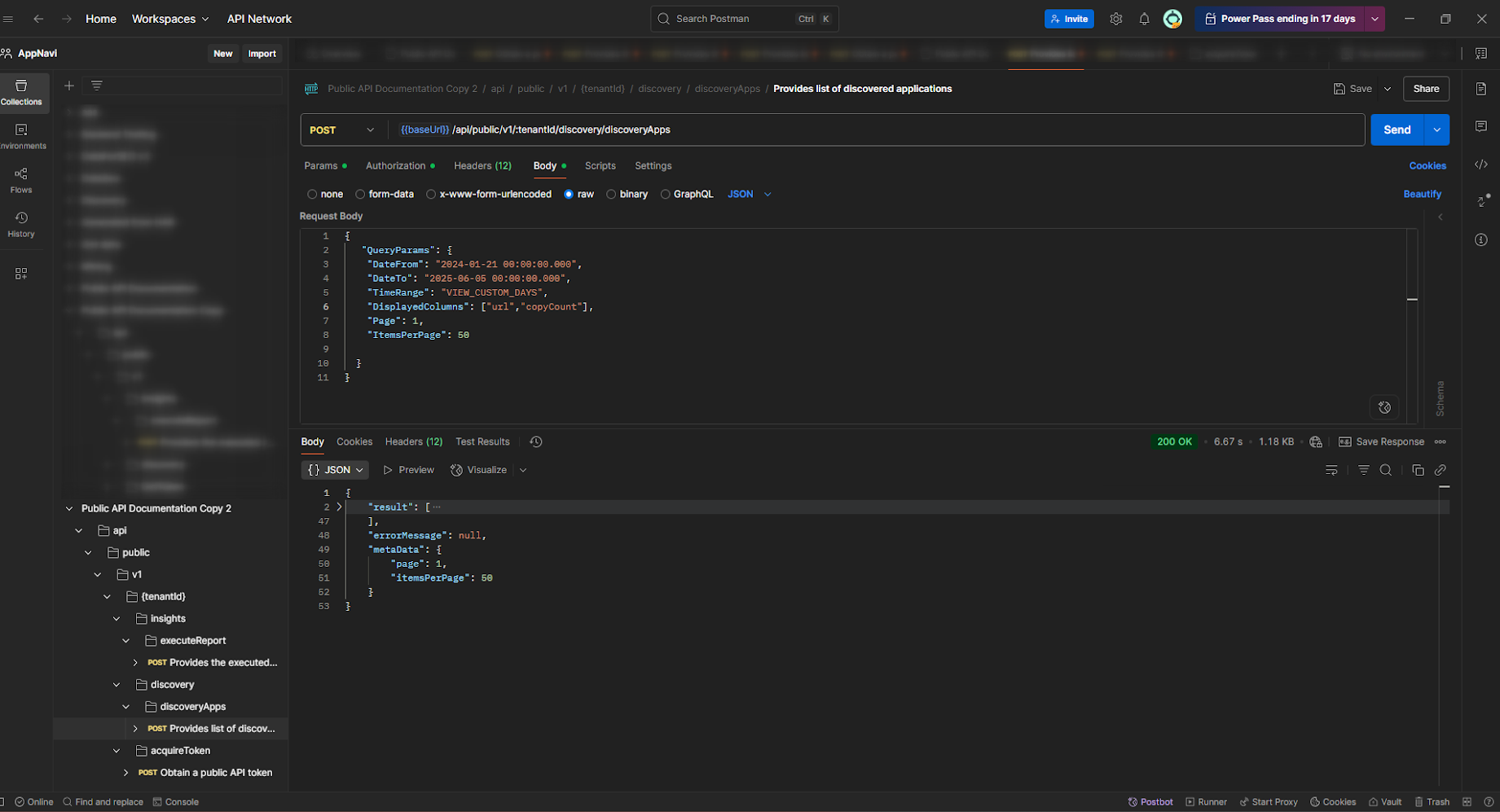
Postman sending a POST request to the discoveryApps endpoint.
Response Behavior:
- The
resultarray contains objects with only the requested columns. - Each object inside result includes only the columns requested in the API query.
- The structure of each object may vary depending on the requested fields.
- errorMessage will be null if the request is successful; otherwise, it will contain error details.
- metaData provides pagination information such as current page and items per page.
Example Response:
{
  "result": [
    {
      "title": "Example App",
      "url": "https://example.com",
      "vendor": "Example Vendor"
    }
  ],
  "errorMessage": null,
  "metaData": {
    "page": 1,
    "itemsPerPage": 25
  }
}
Related Documentation
• Getting Started with the Public API: setting up Public API access and credentials.
• Acquire Authentication Token: getting the bearer token required for this endpoint.
• AppNavi Public API's: overview of all available public endpoints.
• Execute Report (v1): running AppNavi reports through the API.
• Discovered Apps Overview: the same discovered apps data as shown in the AppNavi UI.
• App Discovery: how AppNavi discovers web applications.
• Shadow Apps: identifying unmanaged applications.
• Data Classification: how data classification values are assigned.
• PII Exposure Detection (Copy & Paste): background for the PII inflow/outflow and copy/paste scores.
• AppNavi Discovery – Microsoft Defender API Integration: combining discovery data with Microsoft Defender.
Updated 7 days ago