
Company Apps
Company Apps are the applications your organization has officially recognized for business use. In AppNavi, they are a subset of your Discovered Apps: every app found through user activity is either marked as a Company App or remains a Shadow App until someone reviews it.
This page explains how Company Apps differ from Shadow Apps, how apps are classified (manually or by rules), and how to find, filter, edit, archive and export Company Apps in the AppNavi Portal.
Related pages
• Discovered Apps Overview: how apps are discovered and the full list of discovered apps.
• Shadow Apps: discovered apps that have not been marked as Company Apps.
• Archived Apps: apps removed from the active tables and charts.
• Discovery Setup: classification rules, blacklist patterns and risk configurations.
What is a Company App
A Company App is an application that meets all of the following conditions:
• It has been discovered through user activity.
• Its Company App property is set to true, either manually or by a classification rule.
• It supports internal business operations or services.
Marking an app as a Company App means your organization has authorized it for company use. It does not, by itself, mean the app has passed a compliance review. Compliance is tracked separately with the Compliant property in the app's edit dialog, and risk details such as sensitive data and criticality are recorded on the same dialog.
Company Apps vs. Shadow Apps
The App Overview page has three views, selected with the toggle at the top right: Discovered, Company and Shadow. Discovered shows every app found through user activity. Company and Shadow split that list based on the Company App property.
| Aspect | Company Apps | Shadow Apps |
|---|---|---|
| Definition | Discovered apps your organization has authorized for business use. | Discovered apps that are in use but have not been authorized as Company Apps. |
| Company App property | True | False (not set) |
| How an app gets here | An admin marks it manually, or a classification rule matches its title or URL. | Any discovered app that is not marked as a Company App, manually or by a rule. |
| Where to find it | Discovery → App Overview → Company | Discovery → App Overview → Shadow |
| Edit dialog title | Edit Company App | Edit Shadow App |
Accessing Company Apps
-
Open the Discovery section from the left navigation.
-
Select the App Overview tab.
-
Use the toggle at the top right and select Company.
The Company Apps table lists every app with the Company App property set to true. You can narrow the list with the Countries, Organizational Units and Departments selectors above the table, or search by name. Columns include Title, Application, Business Capabilities, Data Classification, Business Process, Category, Hosting, Criticality Level, Primary Data Location, Sensitive Data / PII and AI Productivity Tool. Scroll horizontally to see all columns.
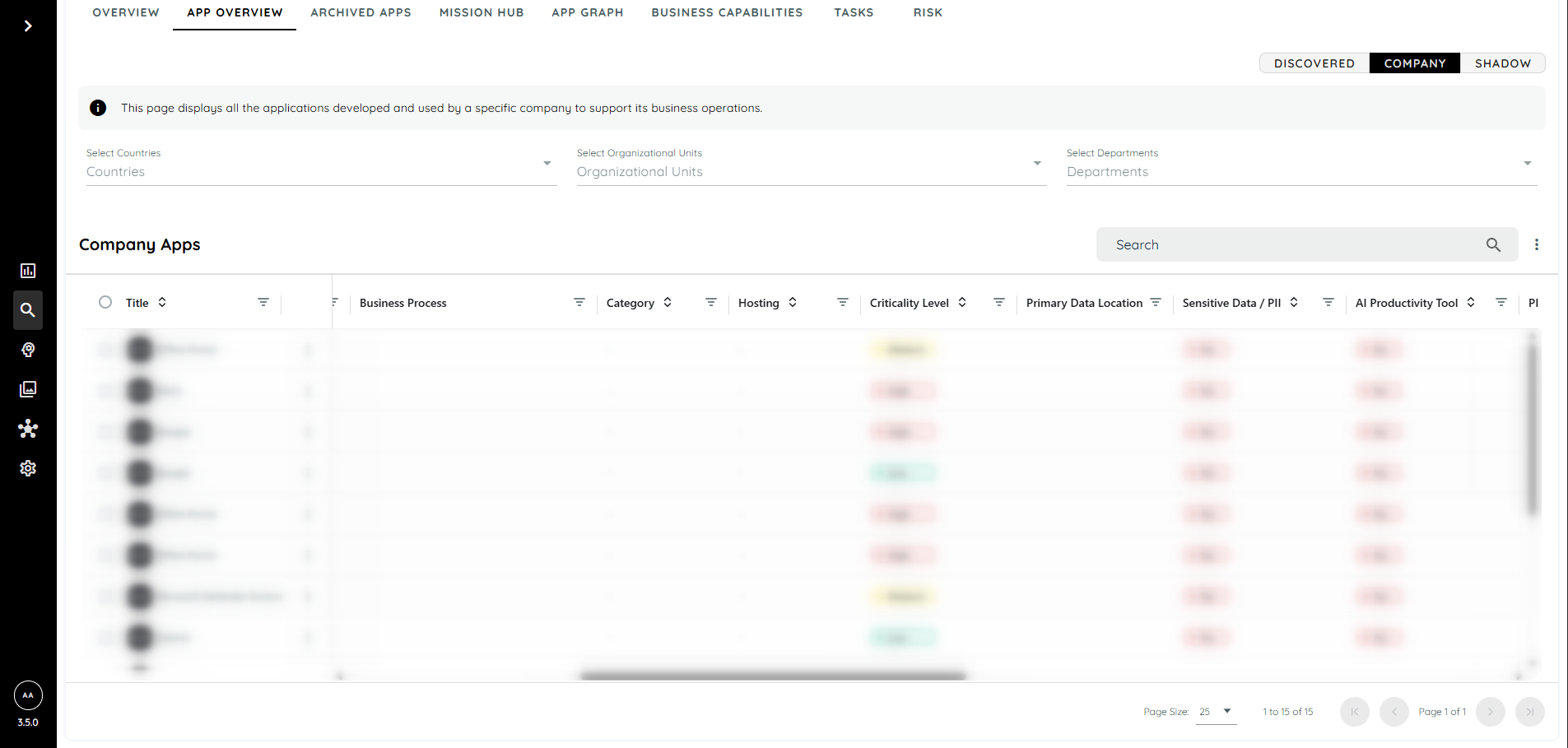
The Company Apps table, opened from Discovery → App Overview → Company.
Filtering the Company Apps table
Each column header has a filter icon. Depending on the column, the filter is either a text condition or a list of values.
The Company App table uses AG Grid, which provides powerful filtering capabilities:
- Users can apply Advanced Filters using operators such as:
- Equals
- Exists
- Contains
- Begins With
- Select Apply to filter or Reset to clear the filter.
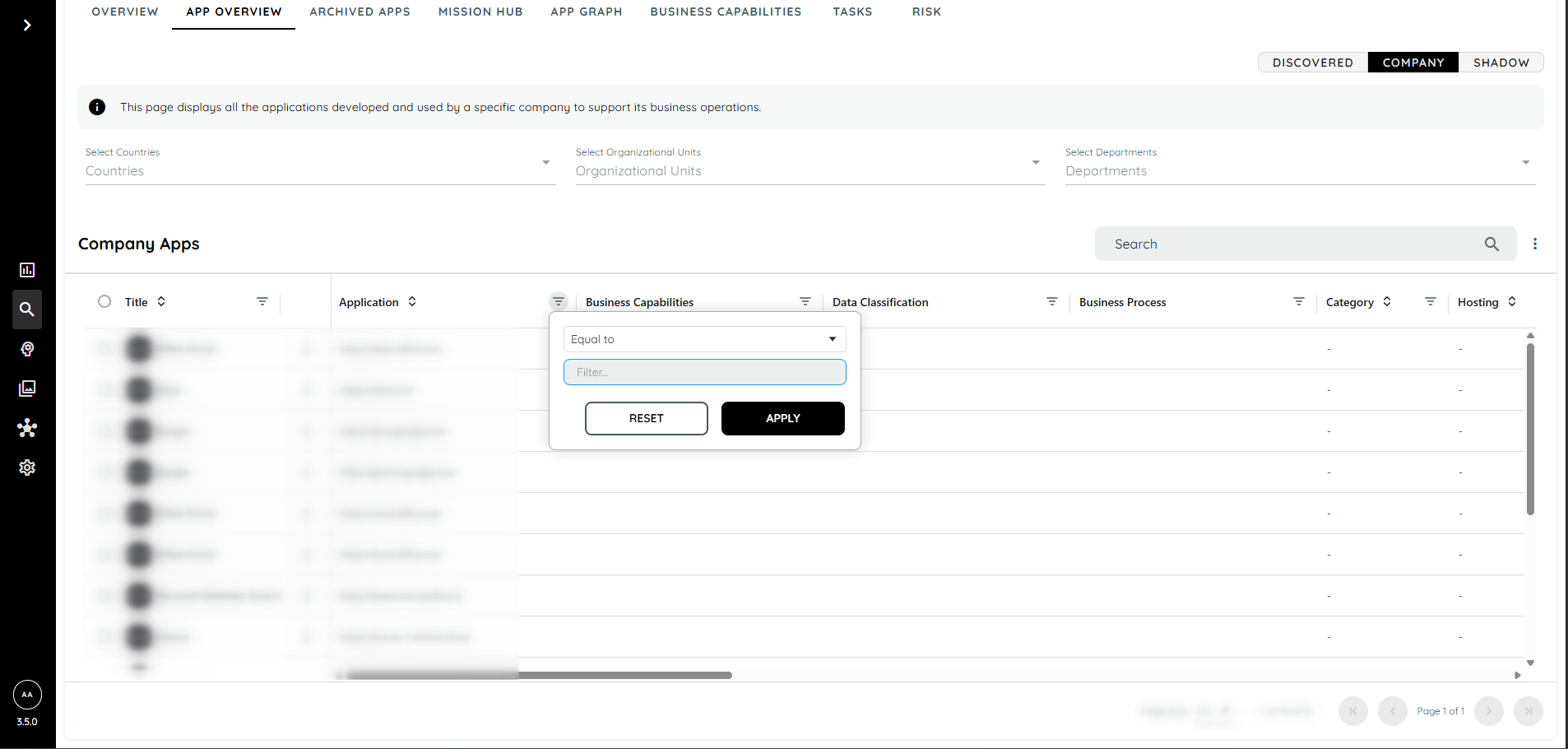
A text condition filter on the Business Capabilities column.
Value list filters
Columns with fixed values, such as Hosting or Category, show a searchable list of checkboxes. Clear the values you want to hide and select Apply.
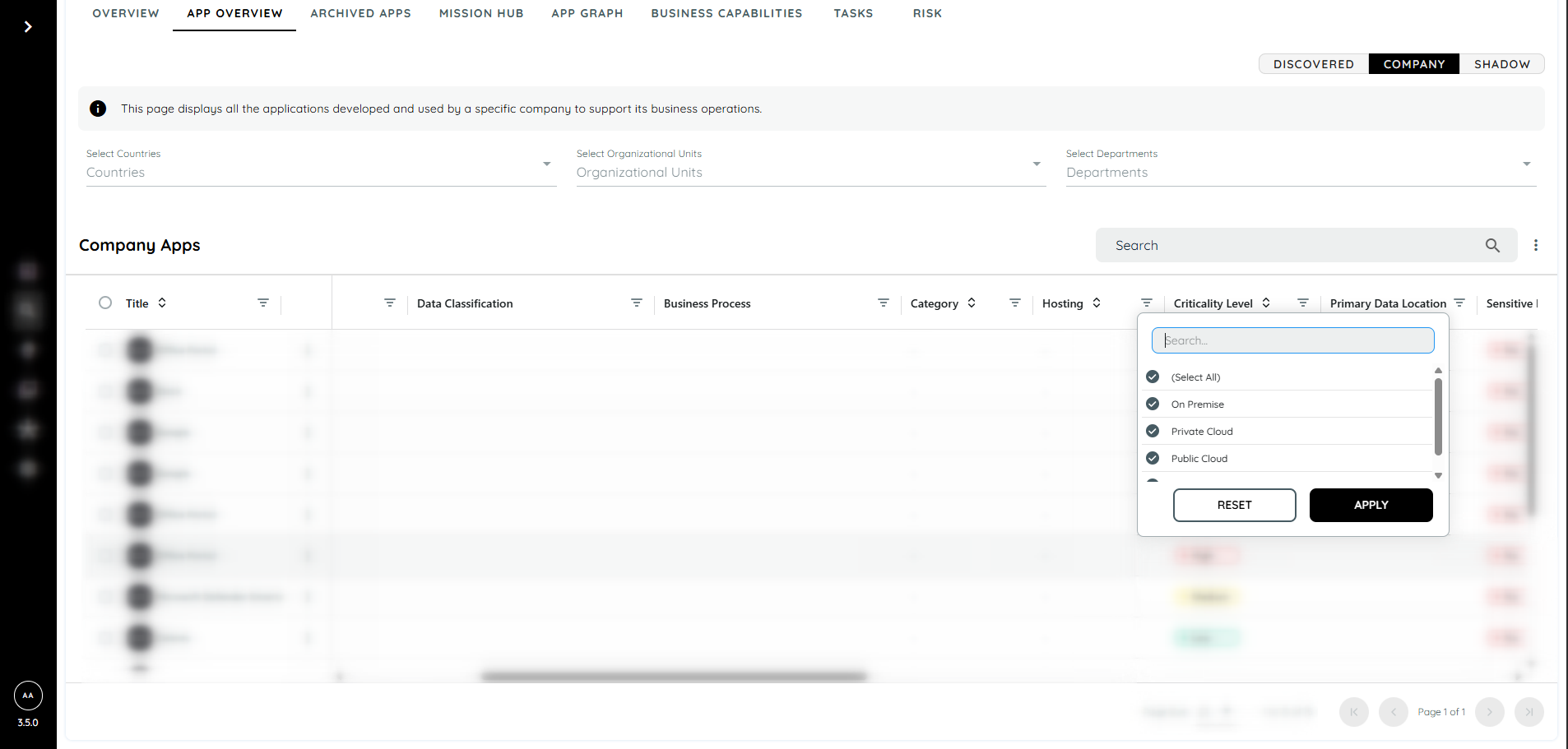
A value list filter on the Hosting column.
This table shows all discovered apps which have set the property 'Company App' as true
Marking an app as a Company App manually
You can mark any discovered app as a Company App. Apps that are not yet Company Apps open in a dialog titled Edit Shadow App.
- Go to Discovery → App Overview and select the Discovered or Shadow view.
- Hover over the app and open its context menu.
- Select Edit App.
- On the Basic tab, select the Company App option.
- Select Save.
The app now appears in the Company view. Because this is a manual change, classification rules will not override it.

The Edit Shadow App dialog. Select Company App (highlighted) and save to approve the app.
Rule Based Classification
AppNavi Portal allows users to automatically classify apps using rules based on patterns or specific app entries.
How It Works
- Patterns: Users can add patterns or exact app names/URLs to mark them as Company Apps.
- Targets: Rules can be applied to either the app title or the URL.
- If URL is selected, the pattern should match the app’s URL.
- If Title is selected, the app will be classified as a Company App if the title matches the pattern.
Note: User can add upto 10 patterns
Example Matches
| Rule / entry | App detected | Result | Why |
|---|---|---|---|
| bosch (pattern, URL) | bosch-connect.com | Company App | The URL contains the pattern "bosch". |
| SAP Hana (title) | SAP4Hana - Portal | Company App | The title matches the SAP Hana entry. |
| URL: google.de/search | google.de | Company App | The URL entry matches the app's domain. |
| Title: Zoom | VideoConf by Zoom | Company App | The title contains "Zoom". |
| amazon (pattern) | flipkart.com | Not classified | Neither the URL nor the title contains "amazon". The app stays a Shadow App. |
| Title: Microsoft Teams | MeetingHub Pro | Not classified | The title does not contain "Microsoft Teams". The app stays a Shadow App. |
Adding Classification Rules
- Go to Discovery → Overview.
- Open Discovery Settings and select the Classification Rules tab.
- Open the context menu next to the search box and select Add Rule.
- Enter the pattern, choose the target (Title or URL), and save.
You can add, edit, delete, search and sort rules from the same table. Rules run during discovery and again every night. They do not change apps whose Company App flag was manually set by a user.
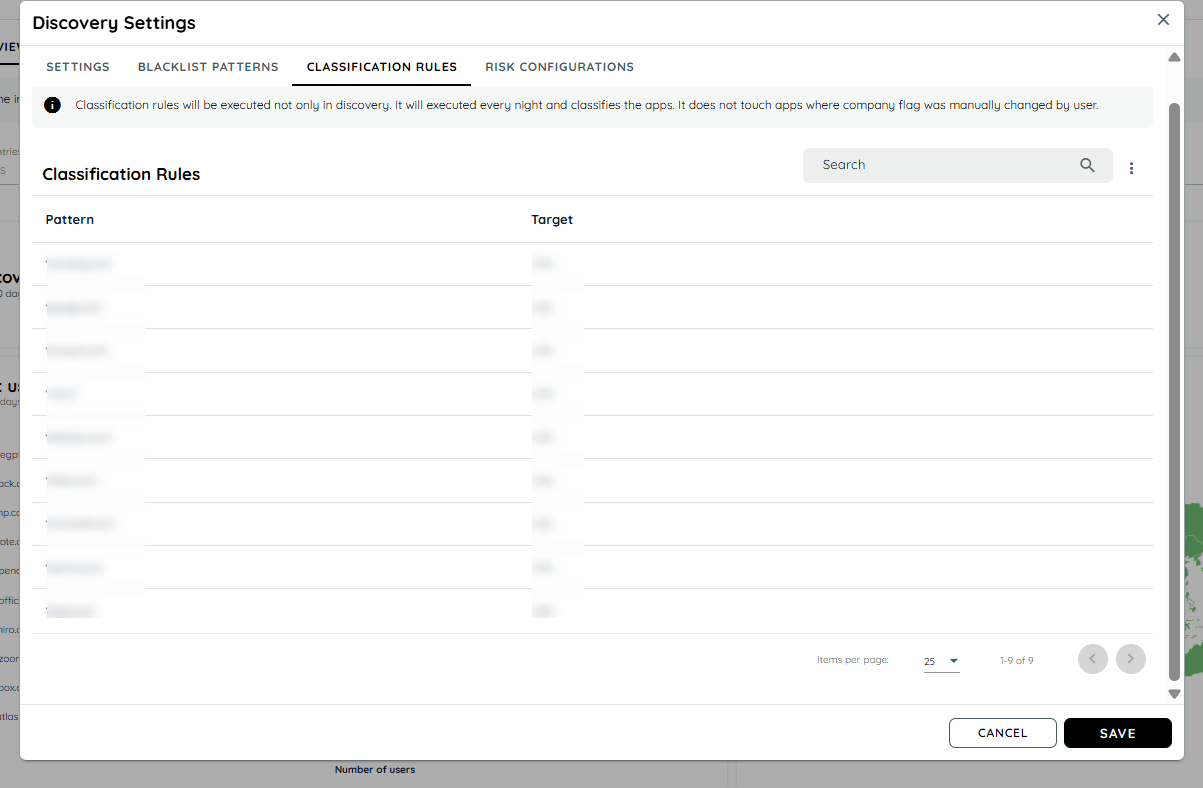
Classification rules in Discovery Settings. Each rule has a pattern and a target.
Users can add, edit, delete, search, and sort all classification rules and entries directly in the AppNavi Portal, making it easy to manage and organize app classification settings.
Example Matches:
| Rule / Entry | App Detected | Classified As |
|---|---|---|
| bosch (pattern) | bosch-connect.com | ✅ Company App |
| SAP Hana (title) | SAP4Hana - Portal | ✅ Company App |
| URL: google.de/search | google.de | ✅ Company App |
| Title: Zoom | VideoConf by Zoom | ✅ Company App |
| amazon (pattern) | flipkart.com | ❌ Company App |
| Title: Microsoft Teams | MeetingHub Pro | ❌ Company App |
Editing a Company App
Open the app's context menu in the Company view and select Edit. The Edit Company App dialog opens with four tabs: Basic, Business Capability, Risk and Tasks.
On the Basic tab you can edit:
• Vendor, Category and Hosting
• Privacy Policy and Terms of Service URLs
• Primary Data Location and Criticality Level (High, Medium or Low)
• PII Data Exposure Check, SSO Usage Tracking and Process Discovery toggles
• Sensitive Data / PII, AI Productivity Tool and Company App options
• Data Classification tags
Clearing the Company App option moves the app back to the Shadow view.

The Edit Company App dialog, Basic tab.
Archiving a Company App
Archive an app when it is retired, replaced or no longer relevant.
- Select the app using the checkbox next to its title.
- Open the context menu at the top right of the table.
- Select Archive.
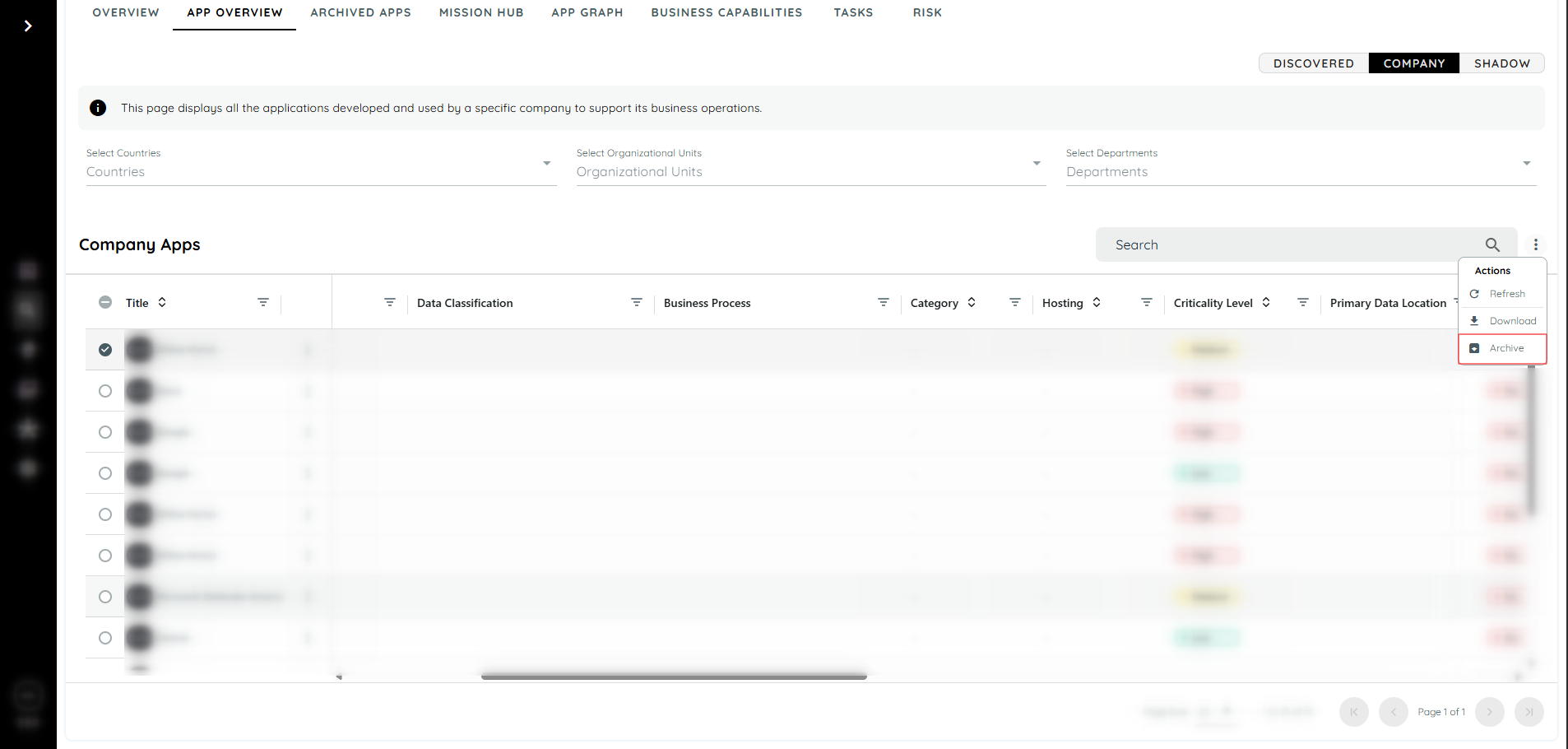
Archiving a selected app from the Actions menu.
After the nightly update, archived apps are removed from the Company and Discovered Apps tables and excluded from charts. You can find them on the Archived Apps tab.
Exporting Company App data
- Open the context menu next to the search box.
- Select Download.
- AppNavi generates a CSV file of the current table view.
The export reflects the filters and columns currently applied, so set them before downloading. Use the file for audits, reporting or offline analysis.
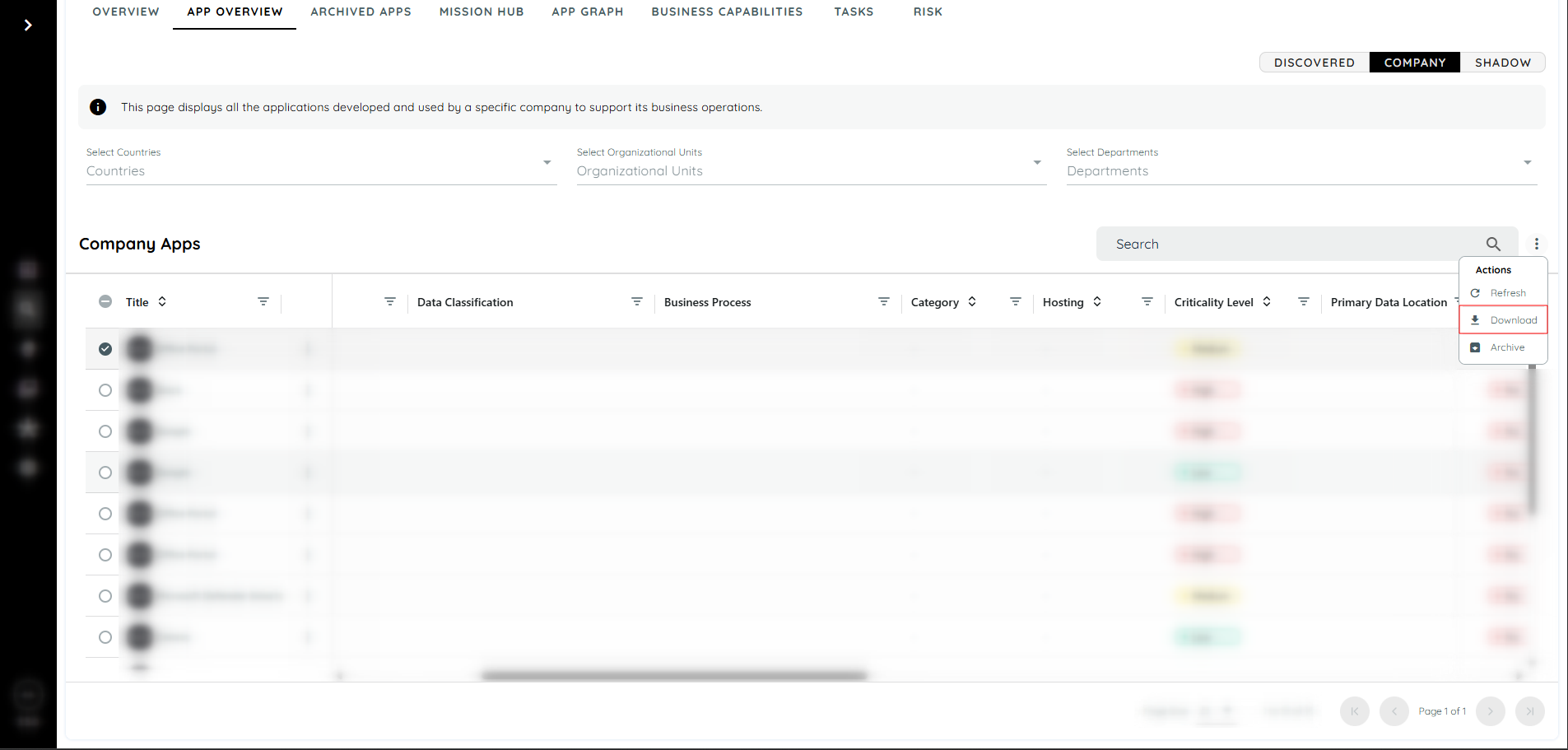
Downloading the current Company Apps view as a CSV file
This feature helps retain a local copy of Company app insights for auditing or analysis purposes.
Updated 18 days ago