
Discovery - Demo BC Suggestions
Business Capability (BC) Suggestions provide recommended Business Capabilities for applications included in Discovery Demo Data.
This feature is designed to help you understand how AppNavi can associate applications with relevant Business Capabilities before applying the process to real customer data.
When you import Discovery Demo Data, BC Suggestions are generated for the imported applications. You can review the suggestions, select the capabilities that are relevant, and save them as Business Capabilities for the application.
Availability: BC Suggestions are available only for partner tenants.
How BC Suggestions Fit Into Discovery
BC Suggestions are part of the broader Discovery → Business Capabilities workflow.
The demo workflow is:
Import Demo Data → Review Discovered Apps → Review BC Suggestions → Accept relevant suggestions → Save → View assigned capabilities in Discovery and BC Overview
The demo data provides sample applications so you can explore this workflow without waiting for real application usage data to accumulate.
For an overview of how Business Capabilities are organized and assigned across applications, see BC Overview.
Before You Start
Make sure that:
- You are using a partner tenant.
- Discovery Demo Data has been imported.
- You have access to the Discovery section.
- The imported applications are visible under Discovered Apps.
If you have not imported the demo data yet, start with the Demo Discovery Data setup. The demo data creates sample Discovery applications that can then be used to explore Business Capabilities and BC Suggestions.
What Happens When Demo Data Is Imported?
After Discovery Demo Data is imported, AppNavi provides sample discovered applications and related Business Capability information for the demo experience.
BC Suggestions are generated for applicable imported applications and are available immediately after the import. You do not need to wait for the nightly processing job to see the suggestions.
This gives you a complete example of the workflow:
- Demo applications are added to Discovery.
- BC Suggestions become available for applicable applications.
- You review the suggested capabilities.
- You select the capabilities that are relevant.
- You save your selection.
- The selected capability becomes an assigned Business Capability after processing.
- The capability can then be viewed as part of the application's Business Capability classification.
What Is a BC Suggestion?
A BC Suggestion is a recommended Business Capability associated with an application.
The purpose of the suggestion is to help users identify a potentially relevant capability without having to manually search through the entire Business Capability structure.
The suggestions in the demo experience are designed to provide realistic, understandable examples of how applications can be associated with business capabilities.
A suggestion is not automatically accepted as the application's Business Capability.
You review the suggestion first and decide whether it should be assigned to the application.
Find BC Suggestions
To view the suggestions:
- Open Discovery.
- Go to Discovered Apps.
- Review the application list.
- Look for applications displaying the black BC Suggestion chips.
- Select a BC Suggestion chip.
The black chips indicate that BC Suggestions are available for that application.
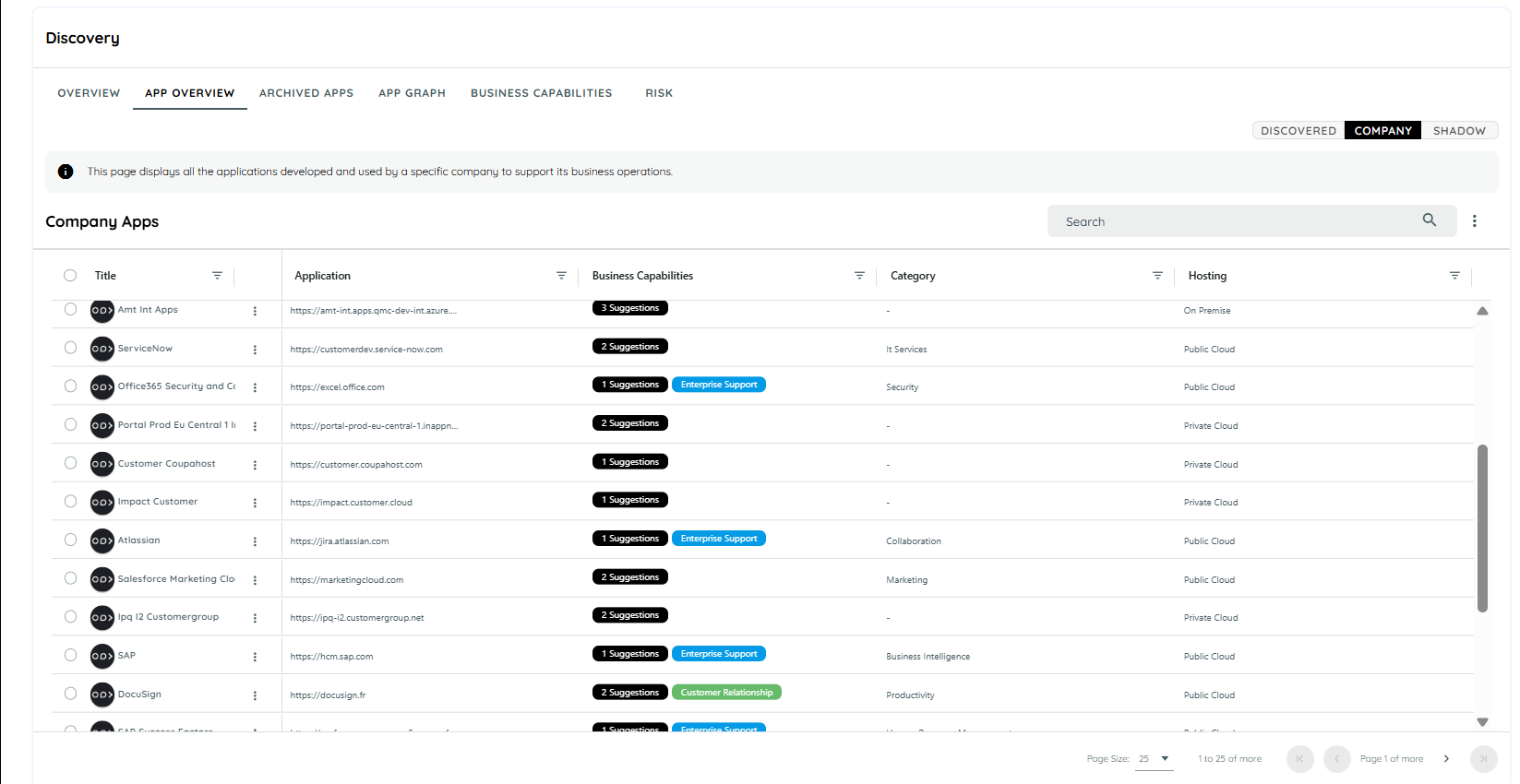
Review Suggestions for an Application
After selecting a BC Suggestion chip, AppNavi opens the BC Suggestions view for that application.
The page displays the Business Capabilities suggested for the selected application.
Review the suggestions and consider whether each capability accurately represents the business function of the application.
For example, a demo application may be associated with a capability related to the type of business activity it supports.
The purpose of this step is to demonstrate the review process that can also be applied when working with real discovered applications.
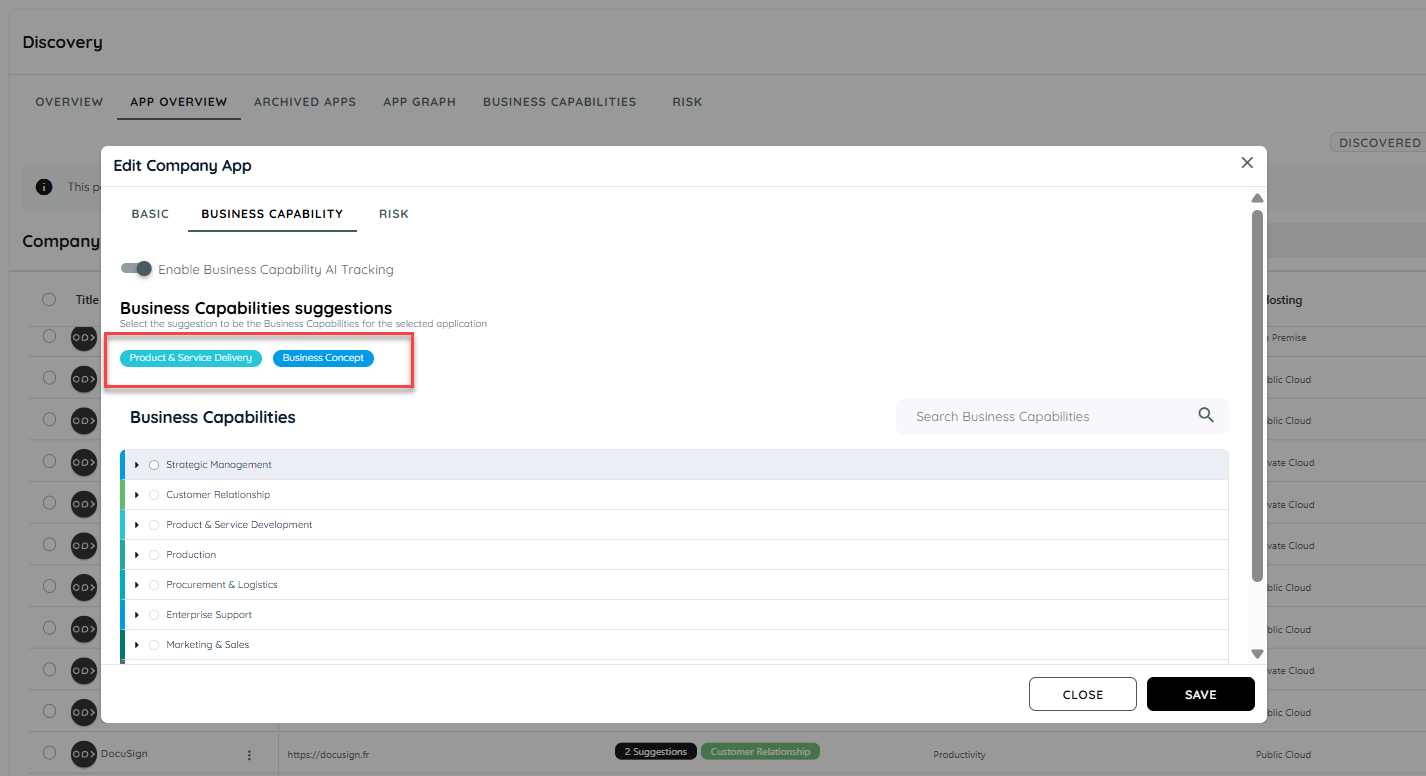
Accept a Suggestion
To accept a suggested Business Capability:
- Open the application's BC Suggestions.
- Review the suggested capabilities.
- Select the capability you want to assign.
- Click Save.
The selected capability is saved as a Business Capability for the application.
What happens after saving?
The selection becomes part of the application's Business Capability assignment.
After the nightly job runs:
- The accepted capability no longer appears as a suggestion.
- The accepted capability continues to appear as a Business Capability for the application.
This distinction is important:
Suggestion = AppNavi recommends a possible capability.
Business Capability = The capability has been accepted and assigned to the application.
Example: Reviewing a Demo Application
Suppose the imported demo data contains an application that supports a particular business function.
The application appears in:
Discovery → Discovered Apps
A black BC Suggestion chip is displayed for the application.
You open the suggestion and see several recommended Business Capabilities.
You review the list and select the capability that best represents the application's business function.
After clicking Save, the selected capability is assigned to the application.
The suggestion is then converted into an accepted Business Capability after the nightly processing cycle.
This demonstrates the same basic decision process that can be used when reviewing Business Capabilities for discovered applications.
Understanding Business Capabilities After Acceptance
Once a capability has been assigned, it becomes part of the application's Business Capability classification.
AppNavi's BC Overview provides a broader view of the Business Capability structure.
Business Capabilities are organized into three levels:
- L1 — Main Business Capability category
- L2 — Subcategory within the L1 capability
- L3 — More specific capability within the L2 category
Applications assigned to these capabilities can be viewed by selecting the relevant capability levels in the BC Overview.
This means the demo suggestion workflow is not an isolated screen. It demonstrates how an application can move from:
Discovered Application → Suggested Capability → Assigned Capability → Business Capability Overview
BC Suggestions vs. Assigned Business Capabilities
The two concepts should not be confused.
| Status | Meaning | Customer action |
|---|---|---|
| BC Suggestion | AppNavi has suggested a potentially relevant capability | Review the suggestion |
| Selected Suggestion | The user has selected the suggestion before saving | Save the selection |
| Assigned Business Capability | The capability has been accepted for the application | Use it as part of the application's classification |
The demo experience allows you to see the transition from recommendation to an assigned Business Capability.
How BC Suggestions Relate to BC Overview
BC Suggestions help you decide which Business Capabilities may apply to an individual application.
BC Overview provides the broader view of Business Capabilities across the organization.
For example:
BC Suggestions
"Which Business Capability could apply to this application?"
BC Overview
"Which applications are currently assigned to this Business Capability?"
The BC Overview contains the complete capability structure and allows users to view categories and subcategories with their assigned applications.
This makes BC Suggestions useful as an application-level starting point, while BC Overview provides the organization-level capability view.
Demo Business Capabilities vs. Demo Suggestions
The Discovery demo experience includes both preassigned Business Capabilities and BC Suggestions.
With Demo Capabilities, some imported applications already have Business Capabilities assigned. This demonstrates how Business Capabilities appear on discovered applications and how users can edit those assignments.
With Demo BC Suggestions, applications provide suggested capabilities that the user can review and accept.
| Demo feature | Purpose |
|---|---|
| Demo Capabilities | Demonstrates applications that already have Business Capabilities assigned |
| Demo BC Suggestions | Demonstrates how users review and accept recommended Business Capabilities |
| BC Overview | Demonstrates the broader Business Capability structure and application assignments |
Together, these features provide a more complete demonstration of the Business Capability workflow.
What Happens When Demo Data Is Deleted?
Deleting Discovery Demo Data removes the demo BC Suggestions and the selected capabilities associated with the demo data.
If you import the demo data again:
- The demo applications are created again.
- BC Suggestions appear again.
- Previous selections are not retained.
- The demo starts with a fresh set of suggestions.
This makes it possible to repeat the demonstration from the beginning.
Re-importing Demo Data
Re-importing the demo data is useful when you want to demonstrate the complete workflow again.
For example:
- Import Discovery Demo Data.
- Open Discovered Apps.
- Review the BC Suggestions.
- Select and save a suggestion.
- Review the resulting Business Capability assignment.
- Delete the demo data.
- Import the demo data again.
- Review the suggestions again.
The newly imported demo data does not retain previous selections.
Does a Suggestion Automatically Become a Business Capability?
No, the suggestion is presented as a recommendation for the application.
You must select the suggestion and click Save for it to become the application's selected Business Capability.
This allows users to review recommendations before applying them to an application's classification.
Is the Suggestion Removed Immediately After Saving?
The current documentation states that after saving, the selected capability will no longer appear as a suggestion after the nightly job runs.
It will continue to appear as a Business Capability because it has been accepted.
Therefore, do not interpret the immediate save action as an immediate removal from the suggestion list.
What Data Does the Demo Use?
The BC Suggestions described on this page are associated with Discovery Demo Data.
The purpose of the demo data is to provide sample applications and generated Discovery information so that partner tenants can explore Discovery functionality without relying on their own live application data.
The demo experience should therefore be treated as a feature demonstration, not as an analysis of the customer's actual application portfolio.
Filters and Analytics
BC Suggestions are presented at the application level.
The current BC Suggestions documentation does not define separate BC Suggestion filters, reporting periods, or a dedicated BC Suggestion analytics dashboard.
Discovery itself provides analytics and filters such as:
- Country
- Organizational Unit
- Department
These filters belong to the broader Discovery analytics experience and should not be confused with the BC Suggestion selection workflow.
Exports
The current BC Suggestions documentation does not specify a dedicated export function for BC Suggestions.
BC Suggestions should therefore be understood as part of the application classification workflow rather than as a separate reporting or export feature.
How Customers Should Use BC Suggestions
A practical customer workflow is:
1. Start with Demo Data
Import Discovery Demo Data to populate the tenant with sample applications.
2. Find Suggested Applications
Open:
Discovery → Discovered Apps
Look for applications displaying BC Suggestion chips.
3. Review the Recommendation
Open the suggestion and review the proposed Business Capabilities.
4. Validate the Business Context
Ask whether the suggested capability accurately represents what the application is used for.
5. Accept the Relevant Capability
Select the appropriate suggestion and click Save.
6. Review the Result
After the nightly processing cycle, confirm that the accepted capability appears as an assigned Business Capability rather than as a pending suggestion.
7. Explore BC Overview
Open:
Discovery → Business Capabilities
Use the BC Overview to understand where the assigned capability sits within the L1, L2, and L3 Business Capability structure and which applications are associated with it.
Example Customer Scenario
Consider an organization that wants to understand how its applications support different business functions.
The customer can use the demo environment to simulate the process:
Step 1 — Discover applications
Demo applications are imported into Discovery.
Step 2 — Identify potential capabilities
BC Suggestions provide possible Business Capabilities for selected applications.
Step 3 — Review
The customer checks whether the suggested capability makes sense for the application's purpose.
Step 4 — Accept
The customer selects the appropriate capability and saves it.
Step 5 — Classify
The capability becomes part of the application's Business Capability assignment.
Step 6 — Analyze
The customer opens BC Overview to see the broader Business Capability structure and the applications assigned to each capability.
This gives customers a practical understanding of how Business Capabilities can be used to organize discovered applications.
Related Documentation
- Demo Discovery Data — Use this documentation to understand how Discovery demo data is imported and used to demonstrate Discovery functionality.
- Demo Capabilities — Shows how imported demo applications can already contain Business Capability assignments.
- BC Overview — Explains the Business Capability hierarchy and how applications are assigned to capabilities.
- App Discovery — Provides the broader Discovery workflow, analytics, application data, and Discovery functionality.
Summary
BC Suggestions help customers understand how AppNavi can recommend Business Capabilities for discovered applications.
The complete demo workflow is:
Import Demo Data → Open Discovered Apps → Find BC Suggestions → Review Recommendations → Select a Capability → Save → Wait for Nightly Processing → Review the Assigned Capability → Explore BC Overview
The important distinction is that a BC Suggestion is a recommendation, while an assigned Business Capability is the result of accepting that recommendation.
The demo experience provides a safe way for partner tenants to understand this workflow using sample data before applying the same Business Capability concepts to their own discovered applications.
Updated 14 days ago