Discovery Demo Data
Overview
The Discovery module allows users to import a complete set of demo data to simulate real-world analytics and insights. This helps users explore different features such as app analytics, mission goals, user journeys, and task tracking all with realistic pre-configured data.
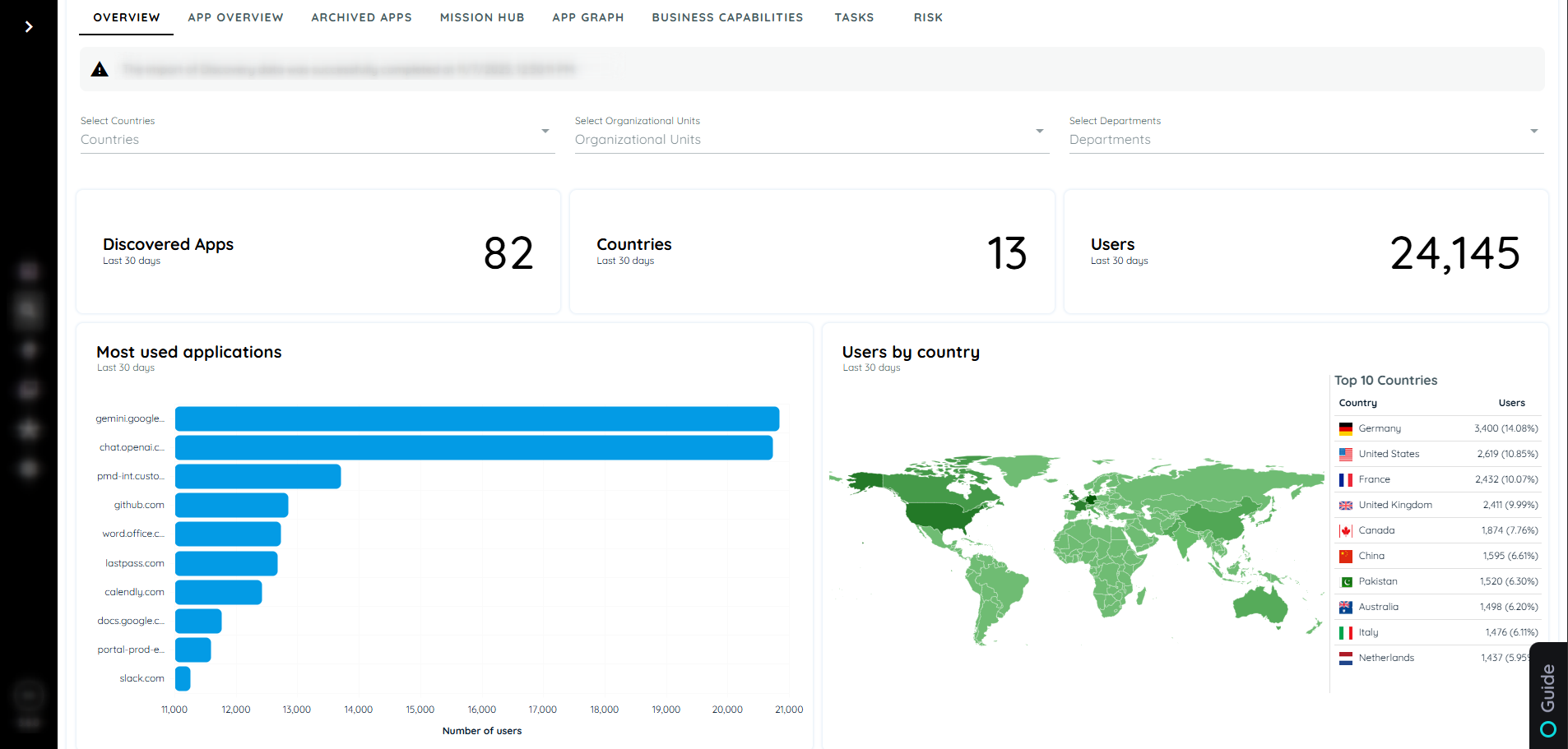
The Discovery Overview tab populated with demo data.
How to Import Demo Data
- Navigate to the Discovery page in the portal.
- Click the three-dots menu (⋮) in the top-right corner.
- Select the Import option.
- In the dialog, paste the Import Discovery Data key.
- Confirm to start the import process.
- Once confirmed, the demo data starts loading and you see the message: “Demo data will appear in your Discovery dashboards within 15 minutes.”
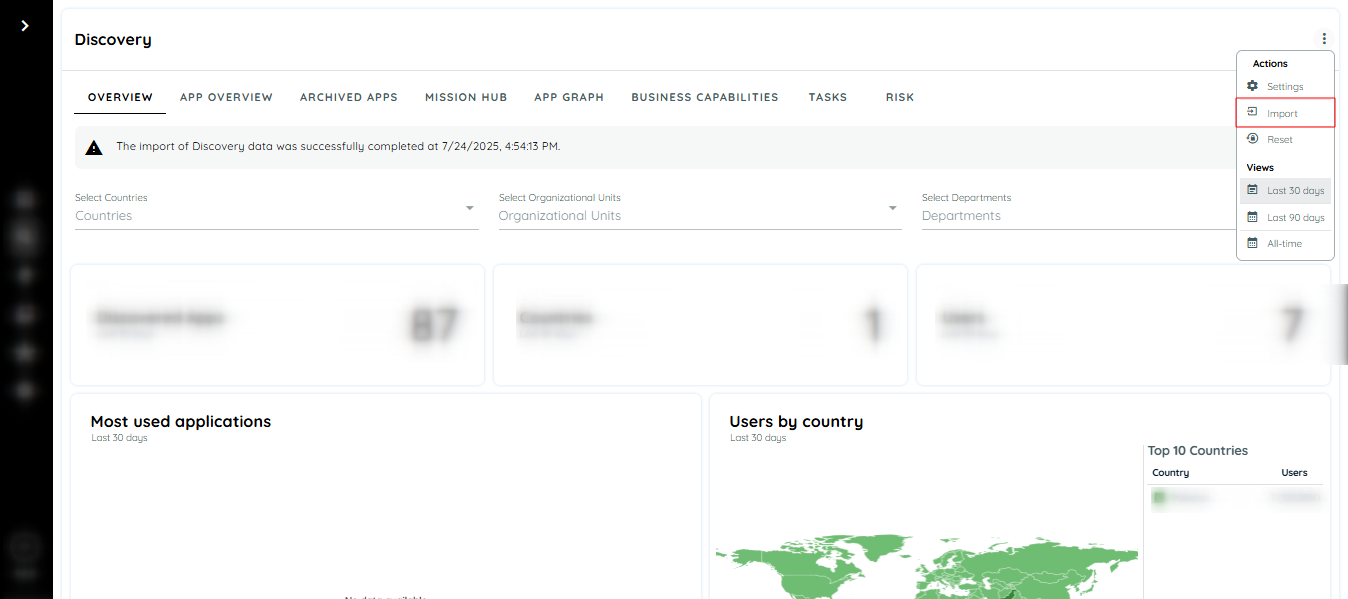
Open the three-dots menu at the top right of the Discovery page and select Import.
What Happens After Import
Demo data appears under Discovered Apps and Company Apps.
Each app includes metrics such as:
• Data Classification
• Business Process
• PII Inflow Risk
• PII Outflow Risk
• Business Capability
• Complete User Metrics
• Overall App Analytics across countries, departments, and organizational units
These columns represent how real applications are analyzed and categorized in Discovery.
To learn more about these views, see Discovered Apps Overview and Company Apps.
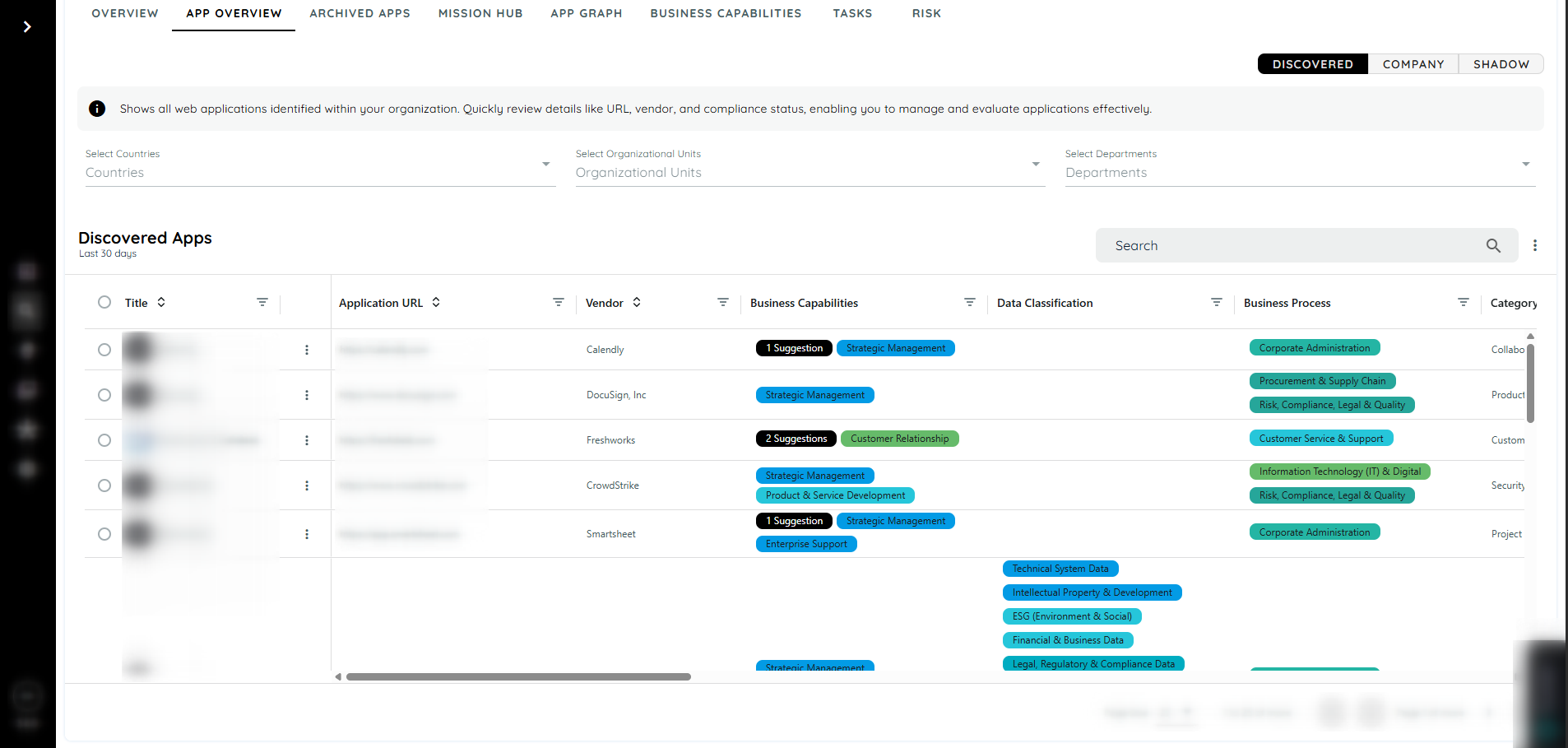
The App Overview tab lists the demo applications
Mission Hub
Demo missions and goals are created automatically.
Each mission includes progress tracking, goal details, and performance analytics — helping users understand how organizational missions are structured and monitored.
For more information, see Mission Hub.
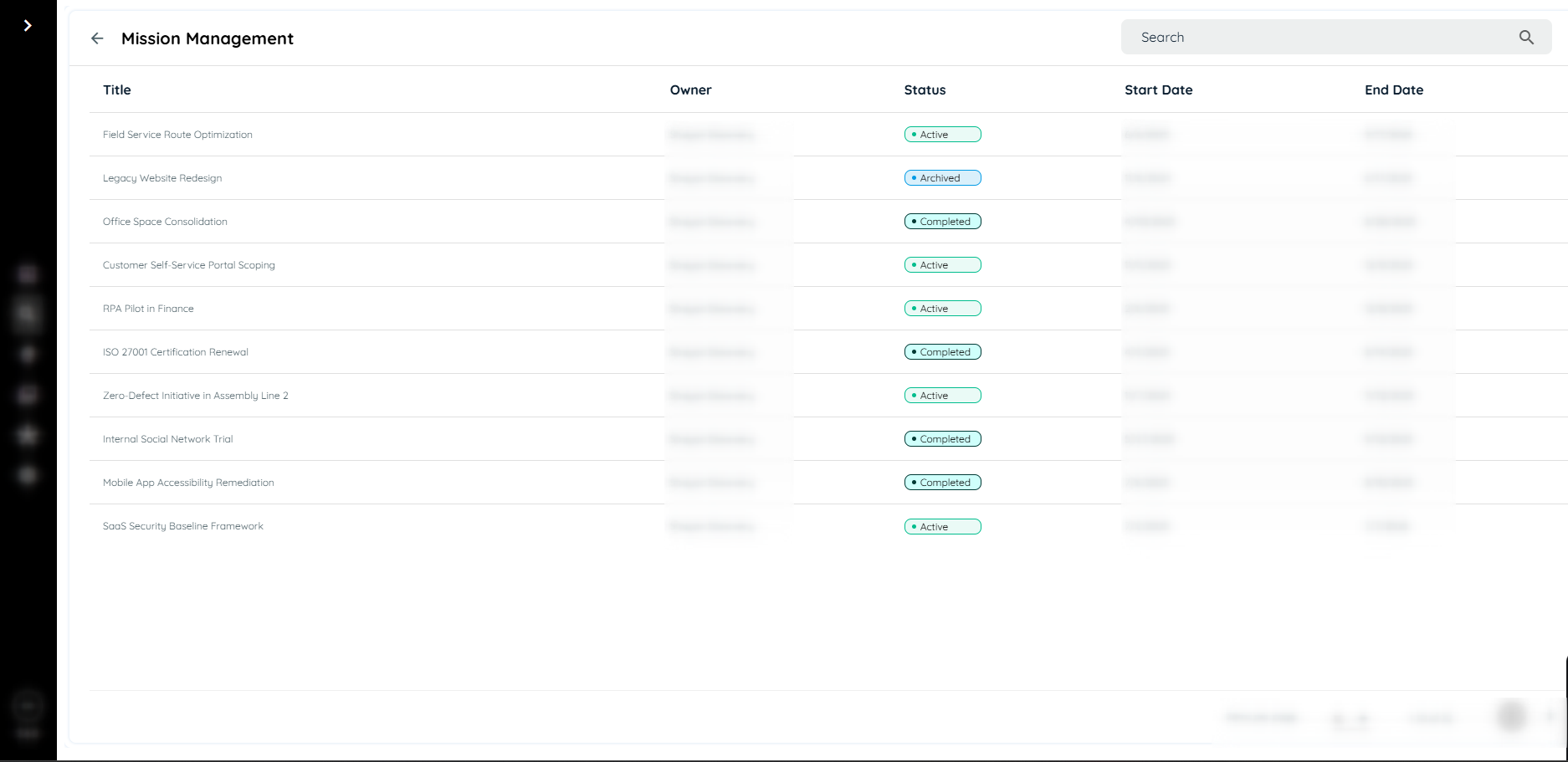
Demo missions in Mission Hub, each with an owner, status, start date and end date.
App Graph
• Pre-configured journey maps display user activity and navigation patterns across applications.
• Users can explore interactive visual graphs showing how different apps and users connect.
For more information, see AppGraph.
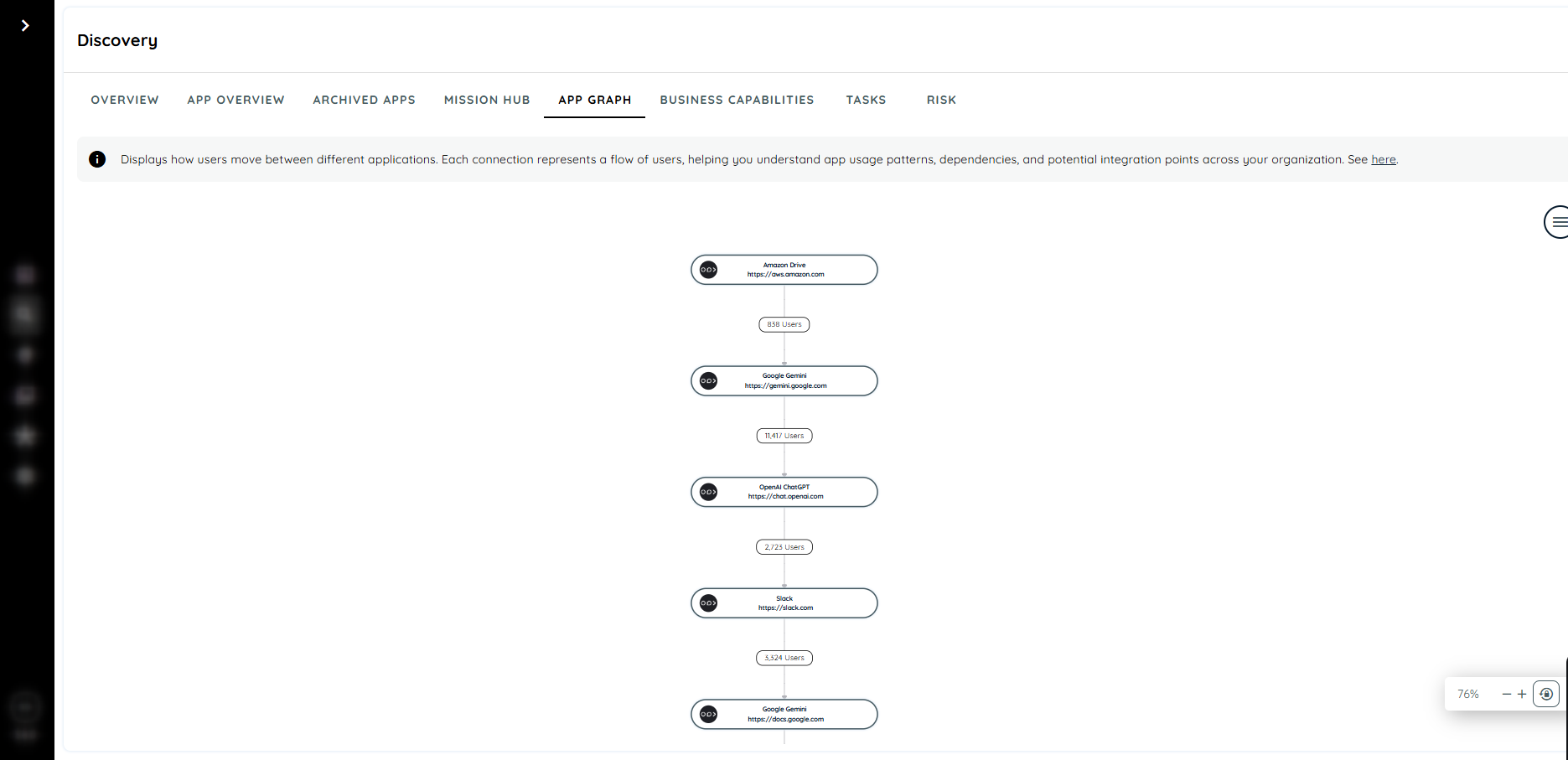
The App Graph shows how users move between demo applications.
Tasks
Sample tasks are generated with demo data including:
• Title, Assigned User, Linked App, Priority, Status, Due Date, and Description.
• This helps users understand task creation, assignment, and email notification features.
• A demo email is triggered automatically to the assigned user when a task is created.
For more information, see Task Management.
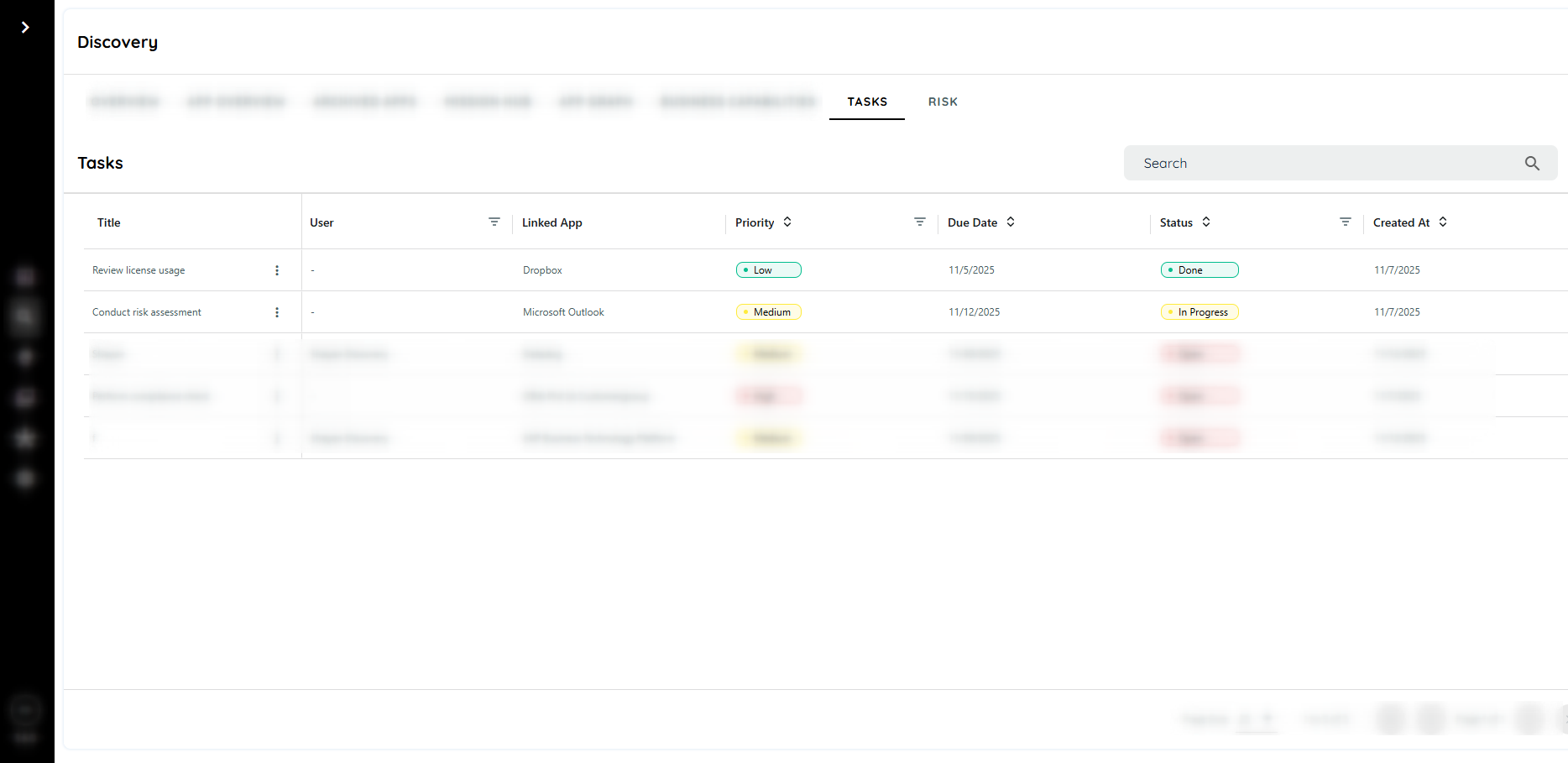
Sample tasks in the Tasks tab, each linked to an application with a priority, due date and status.
Benefits
| Benefit Type | Description |
|---|---|
| Accelerated Onboarding | Helps new users and teams quickly understand how the Discovery module functions without needing access to live production data. |
| Enhanced Decision-Making | Demonstrates how Discovery’s analytics, risk factors, and classifications can guide smarter business and compliance decisions. |
| Improved Adoption | Encourages users to explore and engage with the system more confidently when they see complete, structured demo data. |
| Consistency Across Teams | Ensures every department views the same sample structure, helping maintain uniform understanding and reducing miscommunication. |
| Faster Configuration Testing | Allows internal teams to preview how Discovery settings, journeys, and rules will behave once real data is connected. |
| Strategic Planning Support | Helps leadership visualize how applications, risks, and business processes interconnect — aiding in planning and prioritization. |
| Time and Cost Efficiency | Eliminates the need for manual data entry during setup or training, saving both time and effort across the organization. |
Discovery Demo Capabilities
Discovery Demo Capabilities lets you explore how Business Capabilities (BCs) are assigned to discovered applications using preconfigured demo data.
When Discovery Demo Data is imported, some demo applications already have Business Capabilities assigned. These assignments provide a realistic example of how applications can be enriched with business context and how users can review or update those assignments.
Availability: Demo Business Capabilities are available only for partner tenants.
Before You Start
Before exploring Demo Capabilities:
- Make sure you are using a supported partner tenant.
- Import the Discovery Demo Data.
- Wait for the demo data import to complete.
- Open Discovery → Discovered Apps.
What the Demo Data Provides
The demo dataset includes applications with preconfigured information such as:
- Data Classification
- Business Process
- PII Inflow Risk
- PII Outflow Risk
- Business Capability
- User metrics
- Application analytics by country, department, and organizational unit
Business Capabilities are one part of this broader application information.
The purpose of the preconfigured capabilities is to let you see how business context is displayed on applications before working with your own Discovery data.
What Is a Business Capability?
A Business Capability provides business context for an application.
For example, an application in the demo dataset may have one or more Business Capabilities assigned to it. These assignments help demonstrate how applications can be associated with the business capabilities they support.
The demo data gives you an example of this relationship without requiring you to manually create application data first.
Explore Assigned Business Capabilities
Step 1: Open Discovered Apps
- Open Discovery in the AppNavi Portal.
- Select Discovered Apps.
- Review the application list.
Some applications display colored Business Capability chips.
These chips indicate that one or more Business Capabilities are already assigned to the application.
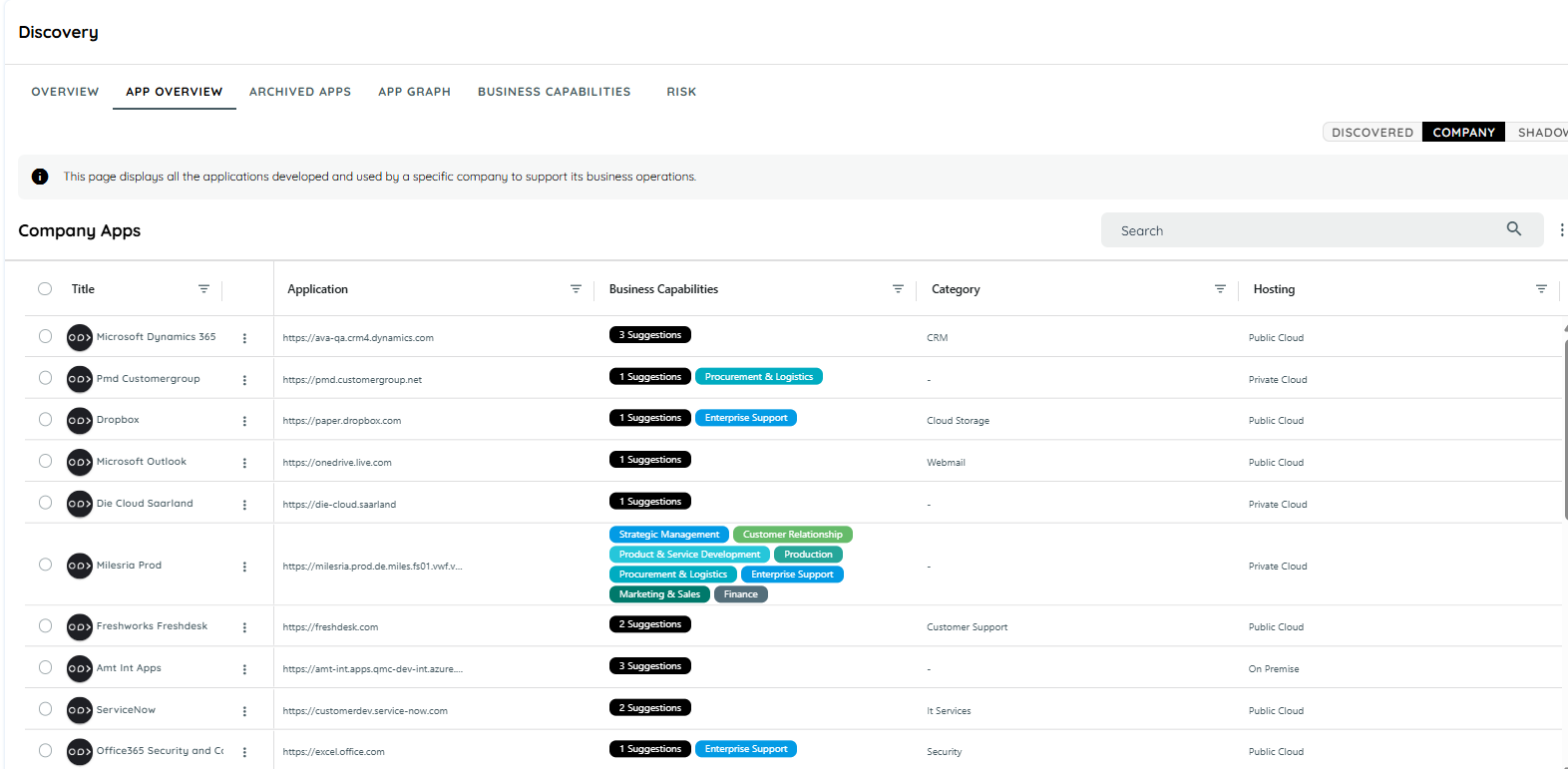
Discovery App Overview
Step 2: Open an Application
- Find an application with a Business Capability chip.
- Click Edit.
- Locate the Business Capability section.
The Business Capability section displays the capabilities currently assigned to the application.
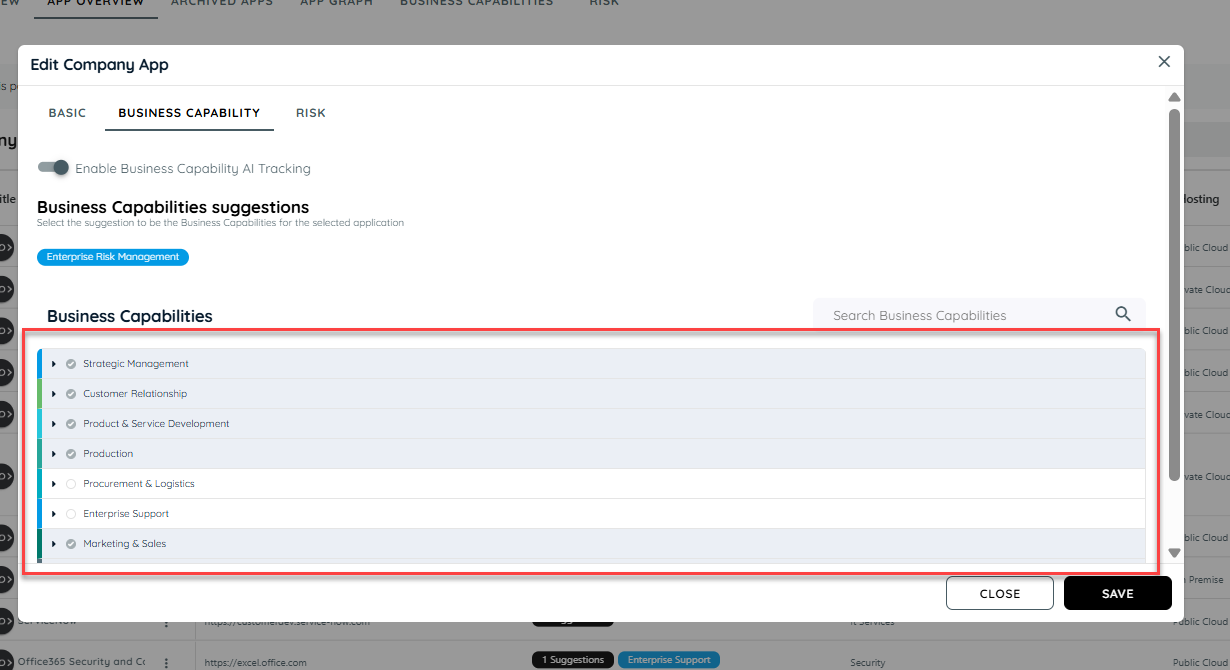
Edit Discovered Apps
Step 3: Review or Change the Assignment
From the Business Capability section, you can:
- Review the currently assigned capabilities.
- Deselect a capability that should not be assigned.
- Select another available capability.
- Save the changes.
Click Save after making your changes.
Example
Suppose a demo application has two Business Capabilities assigned.
You can:
- Open the application.
- Review both capabilities.
- Deselect one capability if you want to demonstrate a different assignment.
- Select another available capability.
- Click Save.
- Reopen the application to verify the saved configuration.
This allows you to see how Business Capability assignments can be reviewed and maintained.
Relationship to Discovery Demo Data
Demo Capabilities are part of the broader Discovery Demo Data experience.
The demo dataset also populates other Discovery areas, including:
- Discovered Apps — applications with example classifications, risks, capabilities, metrics, and analytics.
- Mission Hub — preconfigured missions and goals.
- App Graph — preconfigured journey maps showing application and user relationships.
- Tasks — sample tasks with users, applications, priorities, statuses, and due dates.
This means Business Capabilities should be explored as part of the wider demo environment rather than as an isolated configuration.
Why Use Demo Capabilities?
Demo Capabilities provide a hands-on way to understand Business Capability assignments before applying the concept to real Discovery data.
They allow teams to:
- See how Business Capabilities are displayed on applications.
- Understand how capabilities provide business context.
- Review existing capability assignments.
- Experiment with changing assignments.
- Demonstrate the feature without requiring live application data.
- Restore the predefined configuration by re-importing the demo data.
Updated 7 days ago